I don’t recall which wrestling match was the first I ever watched on television or in person. All I know is that it was in the mid 1970’s and I was 7 years old. I can tell you for certain that it was in Toronto, Ontario, Canada where I was born and where I grew up. I can also tell you that it was only the beginning of the life changing impact that this sport had on the person that I was to become and the career path I chose. Looking back and reflecting, I can honestly say that the impact of professional wrestling on me from a very early age, was the single biggest determining factor in my future success. And so, I’d like to share my revelations and the life lessons that arose from my many years of exposure to the mat game.
 |
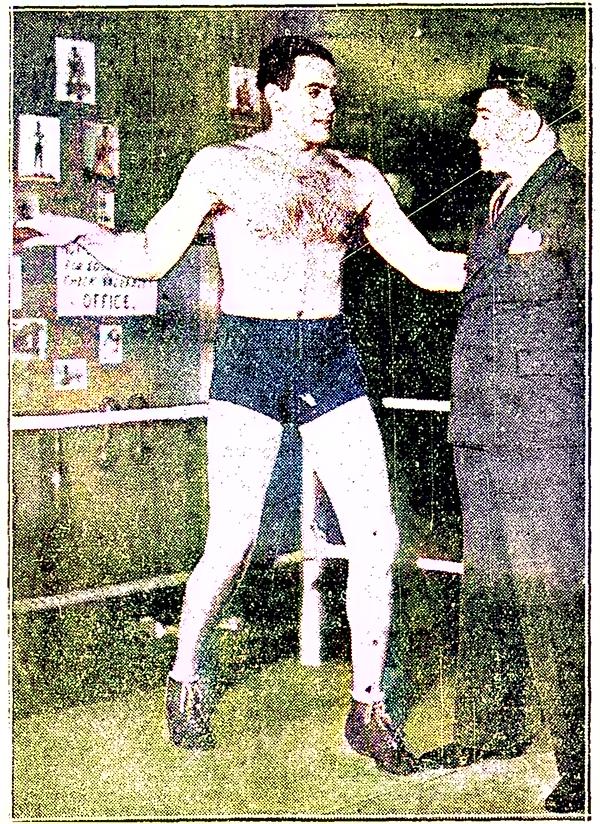
| Like father like son. Reg Russo, Reg with Jeff, and Jeff at 23 |
Toronto was a mecca for professional wrestling in North America and rivaled markets like New York City and Los Angeles for interest and attendance. In fact, it was always one of the most multicultural cities in the world, having a massive fan base of first-generation immigrants from places like Italy that would support their ethnic heroes like Bruno Sammartino. My father was one of those people. He immigrated to Canada in 1951 from the island of Malta at the age of 21 and was a huge wrestling fan. He attended almost every match at Toronto’s Maple Leaf Gardens in the 1950’s and 60’s and then started attending again when he began taking me around 1975. In fact, in the 1950’s, live wrestling shows at the Gardens occurred every Thursday night. My father, Reginald Russo (Reg or Aldo as his friends called him) who was living in downtown Toronto at Queen and Bathurst Street, had a regular ticket scalper that came by his house weekly to sell him ringside seats. Reg was a natural born organizer and leader - he bought seats for all his Maltese and Italian friends, and organized the trips down to the Gardens.
From a very young age he and his friends shared amazing
stories with me of these larger-than-life superheroes like Sammartino, Gene
Kiniski, Lou Thesz and Whipper Billy Watson - their incredible feats of
strength, how tough they were and what cheats and bastards many of the villains
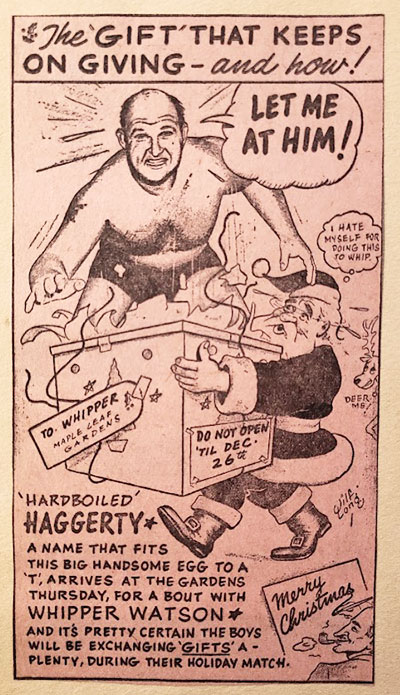
like Kiniski or Hard Boiled Haggerty were. At a time when the cat had not yet been
let out of the bag regarding the legitimacy of pro wrestling, they were
perplexed at how these wrestlers could take such a beating and not have broken
bones or gotten black eyes. In the end,
it was always the same conclusion. They were willing to suspend their disbelief
and chalk it up to the wrestlers just being so much tougher than the average
man and knowing how to defend themselves and take those falls. My father was
fond of saying, “Jeff, you see what hard work, dedication and training can do
for the human body. That constant pounding on the mat and all those blows to
the body and their skin is as tough as a crocodile.” And for a young kid like
me, who was clearly a dreamer from the start and very impressionable, I was
fascinated by the larger-than-life abilities of these men. I believed it was
possible for me to achieve these super human feats. And there was lesson
number one. Hard work and dedication could transform me from average to
exceptional.
And truth and fiction were not so far apart. My dad got to
experience first hand how tough a pro wrestler’s skin really was. On February
17th, 1959 at the Forum in Hamilton Ontario (about a 40 minute drive
west of Toronto), Reg was in attendance with a bunch of his Maltese and Italian
friends including his brother Mario who retold this story numerous times. The
main event match pitted future NWA World Champion and CFL football legend Gene
Kiniski against Italian favourite Ilio Di Paulo. Ilio would go on to open a
famous restaurant in the Buffalo NY area that featured all kinds of wrestling
photos and memorabilia. Kiniski was conducting himself in his usual manner using
rough house and illegal tactics. It got to the point where my father could not
take it anymore and he jumped in the ring and attacked Kiniski from behind,
hammering on his neck and back with forearm smashes and punches. My father was
a very strong and well-built man who was into bodybuilding, boxing and judo
training. He could really wield a punch that would knock most men down. But the
way my dad and his friends described it, he was like a pesky little fly trying
it’s best to make an impact to no avail. Kiniski simply got up, turned around
and then started to chase my dad around the ring and through the arena. My dad,
who was very resourceful, started grabbing the folding chairs at ringside and
whipping them at Kiniski who athletically leap-frogged over every flying
projectile. In the end, my father and his friends were ejected from the
building and banned for one year. Whenever Reg would retell that story, he
never left out the fact that hitting Kiniski on the back felt like hitting
tough leather or crocodile skin.
 |
| Toronto 1959 |
Growing up I had seen my father take down some big guys in confrontations and lift some incredibly heavy objects working in construction. I remember him once carrying a refrigerator single handily up a flight of stairs. He had absolutely no fear and got into many altercations in Malta as a teenager and in his first 10 – 15 years in Canada. In fact, I have an article from the Toronto Telegram newspaper relating how he had been arrested for knocking out a neighbour on Folis Avenue in Toronto with one punch for leaning on his car. The article is entitled the One Punch Boxer. So, I heard this story retold many times by my dad, friends and relatives. It became family folklore. I respected and looked up to my father and revered his confidence and strength. To think that his attack had no effect on this pro wrestler elevated their status in my young and impressionable mind. And so, my second revelation was that there is always someone tougher, stronger and more able.
How could I elevate my game to that level? How would I
fair if and when the challenge arose? And how could I best prepare myself to
face my fears and come out on top? The answer to some of these questions
would be revealed in a few years when I organized a pro wrestling weekly
challenge in a small park in the High Park area of Toronto. And once again my
dad would play his part in the drama by manufacturing a wrestling belt for me
at Anaconda Metals where he worked as a machine operator for close to 30 years.
But before I tell that story, I want to return to the mid
1970’s in our 2-bedroom apartment on the west side of Toronto and try to capture
the history and the sounds and feelings of weekend television wrestling in our
market. I was blessed to grow up in a time and area when cable television was
just starting to take off. Wrestling in our market only aired on weekends but
we definitely had our share of variety. No matter how much homework I had or
what assignment was due, I would never miss watching any of the wrestling shows
with my father. And that continued right up into my university years which
ended in 1990 with me completing a 4-year Honours Degree in Political Science
at the University of Toronto. Also, the year that I followed in my father’s
footsteps and organized a trip to Wrestlemania 6 with my friends and dad at
Toronto’s Skydome. So, the first show that aired on Saturday on a local Toronto
station called Global – channel 41 on the dial, was Verne Gagne’s AWA Wrestling
from the Minnesota area. For me there was one particular wrestler I was drawn
to. A multi time AWA World Champion, Nick Bockwinkel managed by Bobby the Brain
Heenan, was a classy, refined, good looking and well-spoken performer who
managed to hold onto his title using cunning and intelligence. Hulk Hogan who
started his career in the AWA was never able to find a way to take the
championship off of Bockwinkel. Bockwinkel’s manager complimented him perfectly
and possessed many of the same qualities in terms of microphone skills and a
high level of intelligence.
Then on Saturday at 1pm on a local television channel out of
Hamilton Ontario, CHCH channel 11, yes, the same place my dad got into the altercation
with Kiniski, Maple Leaf Wrestling was aired. The show was hosted by long time
Canadian wrestling legend Billy Red Lyons who was best known for his tag team
work with Dewey Robertson (later the Missing Link) as the Crusaders. Each week
Lyons would implore us to come back the following week to watch the show or to
attend a live match at the Gardens with his famous tag line that any wrestling
fan growing up in Toronto in those days could recite to this day, “Don’t you
dare miss it!” Maple Leaf Wrestling, which was an NWA territory at the time,
included a combination of video taped local wrestling matches, highlights from
fights at the Maple Leaf Gardens, and taped matches from Jim Crockett’s NWA Mid
Atlantic Championship Wrestling. In fact, the full Mid Atlantic Wrestling show
would air on CBS channel 4 from Buffalo NY around 3pm on Saturdays.
 |
| 1978 |
It was through these shows that I was introduced to maybe the most influential wrestler on my personal development, the Nature Boy Ric Flair. Like Bockwinkel, he was incredibly well spoken, had an amazing level of confidence, and always had a champion’s air about him. But on top of that, there was a level of intensity, showmanship and charisma that were off the charts. When I first started watching him, he had still not won his first World Championship. He was competing with guys like Greg Valentine and Ricky Steamboat for the NWA United States Championship in some of the most entertaining and intense segments in wrestling television history. What those men did in that small Mid Atlantic TV studio was simply magic and it made a huge impression on me.
Like Gorgeous George
Wagner, who pioneered the ‘look at me’ culture in the early 50’s when
television started, the culture of narcissism, it was an invitation to share in
his self-infatuation or condemn him for it. George broke down the barriers and
Flair took it to the next level just like Mohammed Ali borrowed from George to
create his persona. Flair had the total package that reeked of success and
ultimate confidence. The expensive suits, watches and shoes. The championship
belts for the Mid Atlantic title to the US title to eventually the 10 pounds of
gold NWA World Championship. He was surrounded on the television shows by
numerous beautiful women and claimed to be able to party all night long,
workout the next morning and wrestle a 60-minute match night in and night out,
7 days a week while travelling all over the world. And there it was; revelation
and lesson number three. To be truly successful in life you had to really
believe in yourself. You had to have the gift of the gab, a great vocabulary
and be able to talk a good game and not be afraid or too humble to self promote
and draw attention to yourself. But you also had to be able to back it up by
working hard and training hard and staying ahead of the competition.
I was inspired to grab a dictionary, get out a thesaurus and improve my vocabulary. It encouraged me to practice wrestling interviews, to workout, shape and build my body, and more than anything, to start to believe that anything was possible and that I was going to be great. Like the musician Robert Zimmerman, who recreated himself as Bob Dylan shortly after watching a match with Gorgeous George in his high school in Hibbing Minnesota. I knew, just like Dylan did at that moment, that I would never work for anyone and would create my own path, following my passions and dreams. Like my initial encounter with Ric Flair, Dylan always claimed that he felt anointed after his encounter with George. “His look and mannerisms said, I’m not like everybody else. I’m someone special. And I don’t just accept it, I revel in it.”
Outdoor Wrestling in High Park
Earlier I mentioned the wrestling belt that my father made for
me at Anaconda Metals when I was in grade school, probably somewhere between
grades 6 and 8. At the time you could not purchase any type of replica
professional wrestling belt. No one made them and no wrestling organization
offered them. So, my dad took a risk and smuggled out a piece of brass that he
had someone in the factory cut for him for the belt’s main center plate. At the
time he explained to me that no one was allowed to take any metals from the
company and if he had been caught, he probably would have been suspended or
even lost his job. On and off he worked on the belt for several weeks drilling
it and stitching it all together, and to this day it’s the most precious and
memorable gift I ever received from him. When he passed away in 2013, I draped
his casket with it for the limousine ride to the cemetery. My son Connor then led the procession,
carrying it on his shoulder to the grave site to pay our final respects.
 |
| Jeff and the title belt! |
I can tell you that as soon as I received that belt and put it over my shoulder and around my waist, I felt special, and in some magical or psychological way, it immediately increased my sense of stature and confidence. And that leads to lesson number four. In life you are more likely to act your way into feeling than feel your way into acting. You have to envision something, believe it before you see it and before it shows up in your world. You have to dress for success, put on a championship belt, talk like you’ve already made it, and create an aura of pride and excellence - good things will then follow.
In this case, what followed could have ended up being quite
dangerous and could have gotten me into a lot of trouble. You have to remember
that in the 1970’s and early 80’s, no television wrestling promotion had any
warnings to not try their wrestling moves at home or on any of your friends
because of the potential for serious injury. I thought it was perfectly normal
to want to emulate my wrestling heroes and start fights in the neighbourhood
and at school. I couldn’t wait to show off my one and only championship belt
and defend it every chance I got. To be honest, it never dawned on me that I
would ever lose a match and have to give my belt up.
I should have come to the realization that wrestling my
friends had the potential to end up badly after one of my first encounters at
St. Louis School on Morgan Avenue in either grade 5 or 6. I convinced one of my
friends who I ran the 4 X 100 relay race with, Carlos Munoz, to allow me to
demonstrate the heart punch. I don’t remember if he was questioning the
validity of pro wrestling or if I was simply bragging about my belt and what an
accomplished wrestler I was becoming, but in either case, he agreed to let me
execute the move. Now I had studied former WWWF Champion Stan the Man Stasiak’s
heart punch and of course Ox Baker’s devastating version, and had practiced
pulling one arm behind the opponent’s head thereby opening up the rib cage and
heart area. So, I brought Carlos’ left hand behind his head with my left hand
and then delivered a right-handed punch directly to his heart with everything I
had. You can imagine both my shock, and at the same time, sense of awe as
Carlos immediately dropped to the concrete ground in a heap and totally passed
out. I don’t think I stopped his heart or it missed a beat, or anything like
that, I believe I totally knocked the wind out of him. But whatever it was, I had a bunch of mixed emotions
rushing through me. It totally validated everything I knew to be true, that pro
wrestling was real and that I had the ability to be great at it and defend my
title. At the same time, I started to panic and was so relieved when he came to,
surrounded by a couple of teachers and students and turned out to be ok. I can’t
remember if I was every disciplined by the school for that incident. School
yard fights were more common in those days, and I might have been warned by the
teacher or the principal. All I know is that it did not deter me in the least,
and in fact, fueled my fire to engage in more matches and fights and really try
out all of the moves I had been carefully studying on television and at live
matches.
It didn’t take me long to find a venue and a group of kids
that I could test my skills against on a regular basis. In those days I would
visit my cousins Eric and Mark in the High Park area almost every weekend. Eric
was two years younger than me and Mark was four years younger. I introduced
them both to professional wrestling and we would watch the various shows
together at their place on Glenlake Avenue on Saturday afternoons. I would then practice moves on them before we
would head out for the rest of the afternoon and early evening to meet up with
other friends in the neighbourhood to ride bikes, skateboard and hang out in
parks. We would always meet up with one of my cousin’s best friends who lived
on the same street, a Greek guy by the name of George Karopolis, who also loved
pro wrestling. One of the parks we frequented was on the northwest corner of Glenlake
Avenue and Keele Street. I believe it’s now called Lithuania Park. It was there
that I talked my cousins and George into wrestling me in the grass and trying
out the moves we had watched together that morning on television.
George was bigger than me but I was always able to either
make him submit or pin him. After a few weeks our little exhibitions started to
gain more attention from other kids who would frequent the park. I was also
growing in confidence and stature and started to bring my championship belt
with me. Before long I started to throw
down challenges. In fact, it was probably my first introduction to being a
promoter, learning how to talk smack and get kids fired up to get them to
accept a match with me. I also encouraged my cousins and George to tell kids at
their schools about our matches in the park and about my belt. I went as far as
putting up hand made posters around the area with an open challenge. Years
later I walked into the offices of WWF promoter Jack Tunney to ask him to
donate his ring for a charity wrestling event I organized at my high school. And about 10 years after that I would go on to
promote underground fights with staff and members at a fitness facility that I
was managing long before the Fight Club movie came out.
In the end, I had multiple bouts. I never took on more than one challenger a weekend. In these real fights I don’t think I ever had the opportunity to execute on many moves. I did not realize at the time that to get opponents into figure four leg locks, abdominal stretches and suplexes required total participation from the other guy. Most matches were just a lot of clutch, grabbing and rolling around with me cinching them in a headlock and making the kid give up. I sometimes would use a simple hammer lock and to this day don’t know how I didn’t break someone’s arm. It eventually came to an abrupt end when I bloodied the nose of one boy and made him cry after a punishing headlock. My cousin’s parents got a visit from his parents letting them know what happened and about our little wrestling organization. I retired from the High Park Wrestling League with my championship belt in tact and I am still in proud possession of that original masterpiece. Maybe it should be included in the history of wrestling belts defended in Toronto like the Canadian and North American Heavyweight Championships.
A Few Memories of Maple Leaf Gardens & Maple Leaf Wrestling
My father would have started taking me to regular Sunday evening and occasional afternoon monthly matches at the Maple Leaf Gardens on Carlton Street starting around 1974 or 75. I saved every single ringside ticket stub right up until we stopped attending cards there around 1990. In the early NWA territory days, when Frank Tunney was promoting shows at the Gardens, we probably missed no more than 2 – 3 cards from 1974 – 1983. To this day I can still remember the immense disappointment I felt on those rare occasions when my father told me that we would not be able to attend. I understood how difficult and demanding my father’s work at his steel factory was, and that he would often have to work double or triple shifts to support the family. But it did not make it any easier for me. At that point in my life, there was literally nothing I wanted or longed for more than attending those live events. Keep in mind that the majority of main events and title matches were reserved for the live shows. The television studio wrestling always featured preliminary, average wrestlers, who would quickly lose to the established stars. Rivalries were built up over the weeks through some minor confrontations and interviews with the goal of selling tickets for the arena shows. There was no television or pay per view coverage of these matches, so you really felt like you had missed out if you were unable to attend. There could be a small 5-minute segment of a couple of the main matches shown on the studio show weeks after the event, but that was rare. In fact, if you saw a television camera being set up at the Gardens, you immediately got the sense that something big was going to happen.

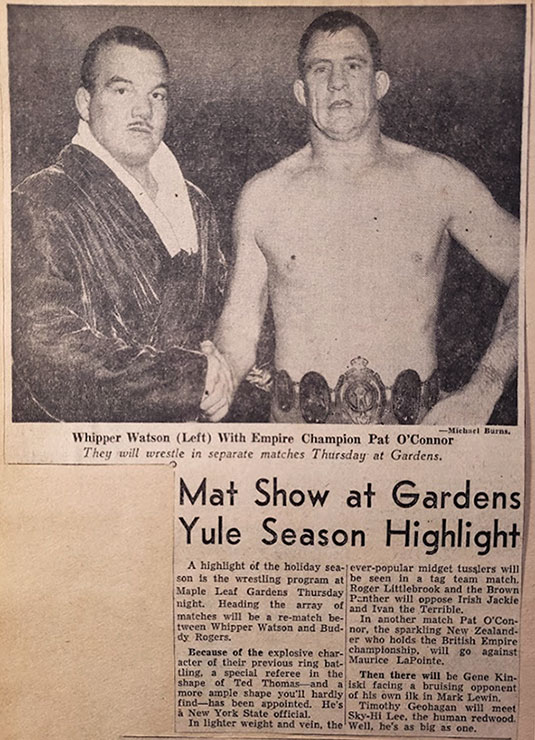
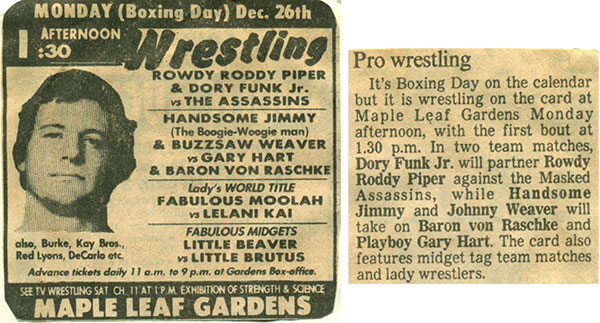
The local Toronto newspapers like the Toronto Star, and more
so the Toronto Sun, featured small advertisements in the sports section for the
upcoming card. They would also publish the results of the matches on Monday
mornings in the sports section. That was pretty much the only way you knew about
the outcomes. I’m still in possession of many of those advertisements and
result summaries that I clipped out of the papers over the years. I was always
a little bit frustrated and annoyed that professional wrestling did not get the
same type of media coverage on television sports reports and in the newspaper
as compared to the other major league sports. I would take great pride and
pleasure when a newspaper featured a longer article on a wrestler. In fact,
those stories usually involved an altercation between a wrestler and a fan or
police officers. The wrestler usually came out on top and I was so quick to
show the article to my friends to prove that pro wrestling was for real and
that these guys were the toughest and best athletes in the world.
In those days, the only way to get tickets for the live
matches was by going down to the arena in person and lining up at the box
office. It’s one of my fondest childhood memories. During the Sunday night
shows, the ring announcer, typically Norm Kimber, would promote the upcoming
show for the following month, indicating that tickets would go on sale at the
box office the following morning. He would announce a couple of returning
wrestlers from the current card and then announce one or two big main events.
Once I was old enough to start taking the subway downtown on my own, I would
get the money for two seats from my dad and head down first thing Monday
morning. I was not in the least bit concerned about being late for class, and I
typically ended up first to third in line every time. Seldom would I be able to
land us a pair of first row A ringside seats. Those pretty much went to season
ticket holders. On a few occasions I was fortunate enough to get the second
row, but more often than not we sat somewhere between rows C and D. And of
course, this was long before cell phones so I had to wait to get back home
after school to share the news with my father. If it was anything beyond row D,
he always voiced a little disapproval. I also seem to remember him wanting us
to avoid the first row in case a wrestler was thrown out of the ring on top of
us. Being that close to the action, for all of those cards, was truly an
incredible experience for me. You could feel and hear the action, and the
banter between the wrestlers and the fans made it more captivating. I was also
thankful that we were not sitting at the top of the arena in the green or gray
seats. In those days, people smoked a lot in the arenas, and there was always a
cloud of thick heavy smoke at the top of the building by the first
intermission.
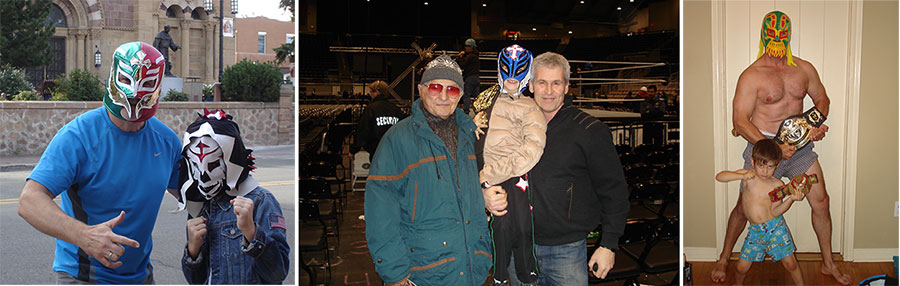 |
| Three generations! Jeff & Connor, Reg, Jeff, & Connor, Jeff & Connor |
After forty plus years, I can still vividly recall and feel the experience of travelling to and from the Maple Leaf Gardens by public transportation. Because we lived in the west end of the city in South Etobicoke, that meant a bus ride up Royal York Road to the Bloor Danforth eastbound subway line. We would then transfer at the Yonge Street station to take the southbound line down to Carlton station. At the Yonge and Bloor station you would be join by a myriad of wrestling fans heading to the event that were coming from all different parts of the city and suburbs. So, my fondest memories involved that south bound train that only needed to go two stops to arrive at the Gardens College Station. Up to the 1980’s, or maybe even early 90’s, the Toronto Transit Commission (TTC) ran the original old red subway cars on that line. I remember being packed into them like sardines and they would rattle, creek and squeak and the car lights (which were lightbulbs screwed into old sockets and covered with glass) would go off and on as the train rambled down the tracks swaying from side-to-side causing people to stumble and bump into one another. My dad would be holding onto one of the metal handles that you could pull down from the ceiling of the train car for support, and I would be looking up at him and holding on to his other arm or leg. The mounting excitement for upcoming matches was palpable. People would be talking about who was on the card, who they thought was going to win, who they liked and who they despised. “Did you see what happened on last week’s Maple Leaf Wrestling show?” “Do you think that Race is going to lose the title to Flair tonight?” I always felt comforted and protected being close to my father in that environment and I also felt a special bond to him. It was the one passion and experience that we shared the most.
When the train arrived on the College/ Carlton subway stop
platform, we funneled out shoulder to shoulder, made our way up the stairs to
the street level and walked east towards the Maple Leaf Gardens. When we
ascended the stairs and then joined the hustle and bustle of all the action and
noises on Carlton Street, my excitement continued to grow. Seeing that iconic
Maple Leaf Gardens marquee, lit up with ‘Maple Leaf Wrestling Tonight’ was
literally heaven on earth for me. The train rides home were more subdued, after
expending a lot of energy screaming and jumping out of our seats during the
matches, but were still memorable in a different way. Fans would be discussing
the outcomes of the matches, the main events announced for the next card, and
possibly flipping through a wrestling program they had purchased. In those days
there were very few options in terms of merchandise. Typically, your standard
program with a few articles on some wrestlers and the line up of the card. You could
also buy 8 X 10 black and white photos of some of your favourite wrestlers, but
there were no t-shirts, wrestling belts or wrestling figures. One of my fondest
pieces of wrestling memorabilia is a 1970’s program that my dad purchased for
me, with Andre the Giant on the front cover posing over the city pre-CN Tower. On
the inside was a photo of Elvis Presley, Promoter Frank Tunney and Whipper
Billy Watson from when Elvis played the Gardens, a story on Haystack Calhoun
and a story on Harley Race regaining the NWA Title.

There is one interaction that I had with a wrestling icon from those days, while travelling to the Gardens, that stands out above the rest. As I mentioned earlier, in the mid 70’s Bruno Sammartino was my favourite wrestler and a huge inspiration for me throughout my life. He was one of the main reasons I got into bodybuilding and eventually started a profession in the fitness industry. At the time of this encounter that happened right on Carlton Street, Bruno was in his second run as WWWF Champion. In my mind, and in the hearts and minds of many wrestling fans and writers who produced the wrestling magazines, Bruno was an unstoppable and unbeatable force of nature. But there was one man who ended Bruno’s incredible first title run that went over seven years, and I just happened to walk right by him as he made his way to the arena. Of course, that legend was the Russian Bear Ivan Koloff.
I would have been about 9 years old and both very weary of and
intimidated by what I thought I knew about Russian athletes - about their
desire to promote their way of life and politics, and prove they were superior
by dominating the West in any competitive endeavour. The Central Red Army had
taken Canada to the limit in the 1972 hockey series and they were now starting
to dominate NHL teams. There was a lot of bad blood and tension between our
nations. In those days, I was too young and had no way of knowing that Koloff
was actually a Canadian, and that he was only playing the part of a Russian bad
guy. He had done the unthinkable and pinned Sammartino in 1971 bringing the
crowd at Madison Square Garden to a stunned hush. People were in total shock
and disbelief. Many in the audience were
shedding tears that their Italian hero had been dethroned. So, for an
impressionable young man coming face to face with this dangerous villain, on a
cold dark snowy winter night in downtown Toronto, steps away from the legendary
Maple Leaf Gardens, the encounter brought emotions of awe, fear and excitement
to the surface. I can still see him wearing a huge fur coat and a type of
Russian Cossack hat. He looked as big and wide as a Mack truck. In those days
bad guys never came out of character. I yelled, “Dad, dad, that’s Ivan Koloff”
as he slowly walked by, but he did not make eye contact and continued on his
way without even acknowledging me.
Now I’m so thankful that these wrestlers made every effort
to protect the business and stay in character and role in all situations. It
totally heightened our experiences and allowed us to be fully invested with our
emotions and hearts. No different than an Oscar winning actor taking years to
fully understand and get into his character. To the point of even transforming
his body and looks, so that when he plays the role, the audience is totally
drawn in, can suspend their disbelief, thereby gaining the maximum benefit of
the entertainment experience. And there
is a key lesson in all of this as well. Fiction written well, produced well,
and done well can have a very strong and positive impact on lives. Make time
for and put yourself into that world of make believe and magic whether it’s
novels, theatre, movies or professional wrestling and allow yourself to dream
and believe. It’s the stuff of legends and heroes and we should all be reaching
and striving for the stars. Live in the unknown and in the adventure,
and allow yourself to go wherever the road takes you. Because of
experiences and moments like these, I was able to take the path less travelled,
take risks, and pursue a unique life of passion and adventure, and it made all
the difference in the world. I was and am a dreamer, and I’ve been living out
my dreams to this day.

Another Maple Leaf Garden memory that I cherish and will always stick with me occurred on February 6th, 1977 and Ivan Koloff just happened to be on that card. I was 9 years old and once again in attendance with my father in the third or fourth row in the ringside seats. The match prior to the main event pitted two long term foes who frequented so many cards in Ontario and Michigan - Bobo Brazil versus the United States Champion the Original Sheik. The Sheik was the stuff that childhood nightmares were made of. Take all of the characters of any horror film that terrified you growing up, combine them all, and they wouldn’t come close to the fear that the Sheik brought to children who got to experience his insane brutality, bizarre rituals and horrifyingly scarred face. But it wasn’t the Sheik that made that night extra special for me. In the 1970s, Toronto was a National Wrestling Alliance (NWA) territory. It was definitely a major market, but even so, Promoter Frank Tunney would be able to bring the World Champion to his region no more than a few times a year. So, the fact that on this night NWA Champion Terry Funk would be defending his title against Harley Race was already a pretty big deal. But to actually witness a world title change was truly a rarity for a few reasons. First of all, title reigns would last considerably longer than in the current era. Terry’s brother Dory Funk Jr. held the title for just over four years and Terry was in his fourteenth month as champion. Lou Thesz has several long title reigns including one that lasted almost six years. Secondly, titles usually changed hands in territories or markets where the most influential promoters for the organization had their home base. For the NWA that would often be St. Louis, Chicago or Kansas City. I’m positive that most in attendance that night, including myself, never expected the belt to change hands. However, looking back on the history books, Toronto had three NWA title changes prior to this match indicating how significant this market was to the organization over the years. This would be the final time that the NWA crown would change hands in Toronto, and I was there to take it all in.
Reflecting back, I can’t tell you if it was the atmosphere
and spirit of the hallowed building that made it feel like a big-time major
title fight. It was the same building that was the home to epic confrontations
like Ali versus George Chuvalo. Was it
the larger-than-life personas of Race and Funk, and their methodical styles
that gave it that extra air of championship stature? Was it the NWA Ten Pounds
of Gold, with its incredible lineage going back to 1948, with champions
that my father boasted about and saw wrestle live like Canadians Whipper Billy
Watson and Gene Kiniski? Or was it that I still believed that all of this was
100% real and that the NWA World Champion was the toughest man on God’s green
earth? Most likely, it was a combination of all of those things that created
that mystique for me and for most of the people there in attendance.
At that point, I’m pretty sure I did not know what the Indian
Death Lock was. I was familiar with the Figure Four Leg Lock, but when Race
applied that leg hold to Funk I was mesmerized. The great invincible Terry Funk
could not break the hold which Race had total control of using only one of his
legs. Funk attempted to head butt his
way out, chop and slap his way free, but to no avail. Race just continued to
rock back and forth and drop back to apply more pressure. After what seemed to be a few minutes, Funk
submitted and Race bolted to his feet with his arms raised high in victory. The
match was refereed by resident Garden’s official and former wrestler Fred
Atkins, even though former NWA Champ Pat O’Connor had originally been scheduled
to officiate. As Atkins handed the belt to Race, ring announcer Norm Kimber
grabbed the microphone that would descend to the ring on a cable that was
connected to the score clock above. This added to the majesty and electricity
of the grand spectacle. “The winner of the match, at a time of 14 minutes 10
seconds, with an Indian Death Lock, the new Heavyweight Champion of the World –
Harley Race!” The voice, the tone, the style, the echo through the arena,
sounding so much like the ring announcer in the movie Rocky II calling out
Rocky Balboa as the new Heavyweight Champion of the World.
I had just witnessed the most prestigious championship in
pro wrestling history change hands right before my eyes, in my own home town,
and my young heart rejoiced and celebrated along with Race and so many in
attendance. Something epic had been accomplished, and I not only felt a part of
it, but in that moment, I believed that I could and would achieve great
things. It should come as no surprise
that it was not long after that match that I was already practicing and
perfecting Race’s winning hold on friends and relatives, and issuing challenges
to anyone at school or at the park to see if they could break the hold or not
give up. To this day it remains my favourite submission hold. And as special
and magical as seeing The Ultimate Warrior defeat Hulk Hogan at Wrestlemania VI
in Toronto’s Skydome, a match that I took my father to, for me it never measured
up to or came close to what I experienced on that February night at the Maple
Leaf Gardens.

That brings me to one final memory that I will relate, although there were countless others, that was unique to my experience with Maple Leaf Wrestling. It occurred in 1985 in my fourth year of high school in a small office across the street from Maple Leaf Gardens. But a little back story is required first. As I mentioned, Bruno played a pivotal role in inspiring me to take up weight training and body building at a very early age. But there were others like Superstar Billy Graham, Jimmy Snuka, Ivan Putski and Ricky Steamboat that had outstanding physiques that helped achieve outstanding success in the business. By grade 12, my fourth year of high school at Michael Power / St. Joseph’s Catholic High School, I was 17 years old, bench pressing just over 300lbs, squatting around 450lbs and wrestling on the high school team. I was 5’9’’ and weighing in at about 193lbs. My love for professional wrestling was still at an all time high which inspired me to order a life size 6’7” colour poster of Hulk Hogan through the mail. I hung it up in our high school weight room without permission, and the few guys that trained there with me from the football and wrestling teams loved it. However, the one guy that did not particularly appreciate it was our high school wrestling coach Mr. Mills, and he tore it down and forbade us from putting anything else up. It might be slightly better today, in terms of more respect coming from those so-called legitimate sports and competitors for professional wrestlers as a result of more amateur wrestlers and MMA stars crossing over to professional wrestling and having success in both worlds. But the biases and disrespect that were so prevalent back then are still mostly in place now.
 |
| High School yearbook 1985 |
During that match I was the manager for the St. Mike’s Masked
Marvels. I got heavily involved in the match and was Irish whipped into the
front row of fans that I prepped before the match to ensure they would not be
injured. A couple of students, including my best friend Peter Muscat, moved out
of the way at the last second and I hit those steel folding chairs with a lot
of momentum and got a great reaction. At
the time, the WWF was doing a story line with John Stud and Andre the Giant
with each claiming that neither man could slam the other. I introduced the idea of using our biggest high
school football player Ian Galiota for a body slam challenge. I would be
involved in that encounter and came to the ring all tanned and pumped up in a
Brutus the Barber Beefcake looking outfit minus the scissors. When I was unable
to slam Galiota, I hit him over the back with a chair. Then, football and basketball star Mike Zita
and I double teamed him and double suplexed him. The high school gym was packed
to maximum capacity for this fundraiser. Nothing else like this had ever been
done in school history and I don’t believe has ever happened since. It’s little
wonder that my grade thirteen 1986 year book says the following; “Jeff plans to
go to Madison Square Gardens to win the world wrestling title from Hulk Hogan.”
Now you might ask what this all has to do with Maple Leaf
Wrestling? Well, supposedly there is a VHS tape out there somewhere that has
this whole event recorded. Deighton claimed to have come across it at his home
a couple of years ago but still no one has seen it. If you were able to watch
it, you would notice that our ring was just a huge mound of amateur wrestling
mats piled up on top of each other. They did the trick but I originally had a
much bigger vision. I wanted to have an actual wrestling ring donated and
installed for the event. I had recently been made aware that one of our
students, Jamie McDonnell, was the nephew of acting WWF President figurehead
Jack Tunney. In fact, the word is that Jamie is still in possession of the only
remaining tape. Jack had taken the promotion over from his uncle Frank Tunney a
year or two before our event and brought the WWF to the Gardens ending their
family’s relationship with the NWA. So, I offered to use Jamie’s name and head
down to Jack Tunney’s office to boldly ask for his ring fully expecting that we
would have a good shot. I had known for years that Frank Tunney had his
promoter’s office across the street from the Gardens in a small office tower
that was pointed out to me several times. I had walked into the building’s
lobby a few times over the years and saw Maple Leaf Wrestling listed on the
directory of businesses and seem to recall that it was on the third floor. It
was at 27 Carlton Street and the building is still in existence today with
offices on the first few floors and apartments above.
I think I might have tried to get the phone number for the
office to make an appointment, but I either never found the number, or if I
did, no one answered the phone. I decided to make my way down there and take a
shot a meeting with someone in person on the fly. That area was like a second
home to me and like my own back yard, having by then attended over 100 live
matches at the Gardens. I got off the subway at the College /Carlton station,
and this time crossed the street to the south side and took the elevator up to
the office of Maple Leaf Wrestling. As I opened the door, I noticed there was
no one at the reception desk and it was pretty close to lunch time, but I did
hear some deep booming voices in the back offices. I just waited in the lobby to see if anyone
would come out. It didn’t take long for three large men to appear and I
recognized all of them immediately. Leading the way was Jack Tunney himself. He
was a very tall, broad shouldered and thick individual with a loud deep voice.
Just behind him was one of Canada’s greatest tag team wrestlers with the
Crusaders and commentator for CHCH Maple Leaf Wrestling Billy Red Lyons, no
small figure himself, and ring announcer Norm Kimber. Although I was pretty
large in stature for my size, all three of the men dwarfed me.
 |
| Fit at 50! |
Tunney was the first to speak and asked what he could help me with. I introduced myself and mentioned my connection with his nephew Jamie. That did not get any response or even acknowledgement. I then told him that I had been an avid wrestling fan and how much my family supported wrestling at the Gardens since the 1950’s. I don’t recall much response from him if any on that topic either. And then I told him about our charity event and asked if he would be willing to donate his ring to support us. That’s when he turned to Red Lyons and Kimber and started to laugh. He said something to the effect of “Billy, who is this guy kidding? Charity? He’s going to probably put all the money in his pocket. We’re not interested.” The three of them just walked past me chuckling and talking amongst themselves, heading to the elevators to probably go out for lunch. So we went on with the event, we had a massive turnout, we raised a lot of money for charity without a dime going into my pocket or any other students or staff. It was my first and last professional wrestling match. It was also my very first event promotion but definitely not my last. And here’s my final takeout and lesson from this adventure and challenge. You’ll never have all the answers, have all the dots connected or have the clear path. You’ll never be fully educated or prepared for anything. But the most important thing is to just jump in and figure it out along the way. It’s only in the realm of doing, failing, struggling and persevering where the true learning and the real success will occur.
So, what great event or great day are you saving yourself for? You only have now and that moment has already passed. “Life is what happens to you while you're busy making other plans” – John Lennon
-by Jeff Russo 2022
Photos from Jeff Russo collection, nostalgia mapleleafwrestling.com collection - Thanks Jeff!