Showing posts with label AC. Show all posts

Lists: Titles in Toronto 1929-1984

Pro Wrestling was a myriad of titles with most every wrestler in the classic era holding a title somewhere sometime. Many used old or fictitious claims. Fred Atkins in his early days in Toronto was Australian champ, Carlos Rocha the Portuguese champ, Emile Dupree the Maritimes champ, and many, many more. For the purpose of this list I just listed those titles that were defended and officially recognized in Toronto from the start of the weekly cards in 1929 to the end of the NWA days in 1984.

Main pic AWA Title belt in front of the W in NWA at MLG 1982
I took that as Nick Bockwinkel made his last defense here in Apr 1982 vs Angelo Mosca

Toronto's own titles
  • World Title (Toronto)  1938-1939
  • British Empire Title (Toronto)  1941-1967
  • Canadian Open Tag Team Titles (Toronto)  1952-1961
  • International Tag Titles (Toronto)  1961-1977
  • U.S. Title (Toronto)  1962-1973
  • North American Title (Toronto) 1973
  • U.S. Title (Toronto)  1974-1977
  • Canadian Heavyweight Title (Toronto)  1978-1984
  • Canadian TV Title (Toronto)  1982-1984
  • North American Title (Toronto)  1982-1984

Others 
  • Canadian Title  1929-1941 pre dates the start of the weekly cards in 1929
  • World Title  1929- 1947  pre dates the start of the weekly cards in 1929
  • NWA (Alliance) World Title  1950-1984
  • Canadian Title (CCWA)  1950-1962
  • Middleweight Title (CCWA) 1951-1961  
  • WWWF/WWF Title  1964-1982
  • Women's World Title  1971-1983
  • NWA Junior Heavyweight Title  1972*
  • North American Title (Big Bear circuit only)  1974-1983
  • U.S. Title (Big Bear circuit only) 1974-1982** 
  • AWA World Title  1977-1982
  • AWA Tag Titles  1977-1979
  • AWA British Empire Heavyweight Title  1978
  • U.S. Title (Mid Atlantic)  1978-1983
  • NWA Tag Titles  1979-1983
  • NWA/Mid Atlantic TV Title  1979-1983
  • International Tag Titles (Japan Stars Tour)  1980
  • World Tag Titles (Detroit) 1980 
  • Mid Atlantic Heavyweight Title  1981-1983
  • Mid Atlantic Tag Titles 1981-1982
  • North American Tag Titles (Big Bear circuit only) 1983
  • Intercontinental Title (WWF)  1983

*Danny Hodge was billed as NWA Jr champion in his one bout at MLG in 1972 but had lost it prior. He won it back the next night in Shreveport, LA.
**Sheik title, same lineage as Tunney/MLG for the most part. Sheik lost it at MLG twice.

There were others defended outside Toronto proper including Kasaboski's titles, the Labatt Tag Trophy, Ontario Tag Titles, and more but not included here. 

-AC and photo by...

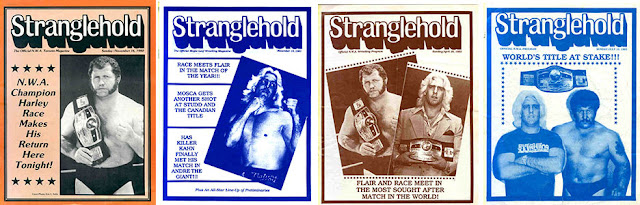
Flair vs Race: Science & Violence

During the Mid Atlantic era 1978 -1984 there were a few matchups that could pack the fans in at MLG. Ric Flair vs Harley Race surely ranks near the top. Their six bouts in Toronto, all over the NWA title, are long remembered by the fans for both their science- and violence. 
At the time of the first match-up in Nov 1980 Race was World champ and Flair was the most popular star in Toronto. He was coming off successful feuds against old tag partner Greg Valentine as well as Hossein the Arab/The Iron Sheik, whom he had just chased to the dressing room to end their latest bout. 

Flair won the NWA title from Dusty Rhodes in Oct 1981 and appeared here as champ for the 50th Anniversary card held in November. They pack 16.000 in for that one and the next time the two match-up was another special card. A double World title card featuring both the NWA and AWA titles. AWA champ Nick Bockwinkel defended against our Canadian champ Angelo Mosca while Flair and Race had another hard fought battle that was action from start to finish. 

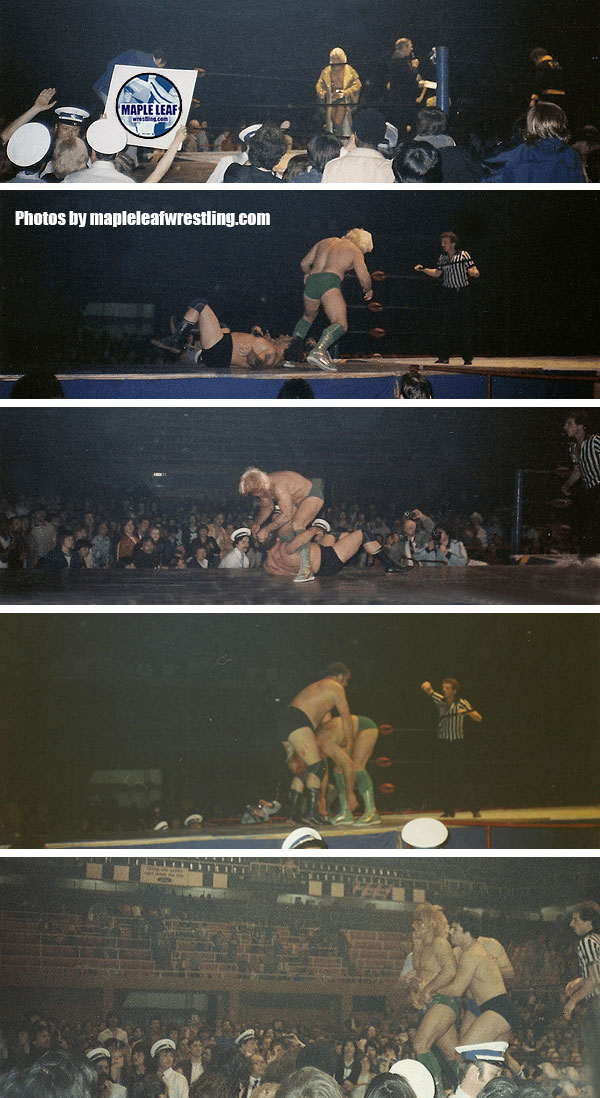
The main photos were taken at that bout. In the sequence the battle rages from the ring to the ramp and Race catches Flair with a piledriver after turning the tables on champ Flair. The last pic of the sequence shows Flair being restrained by Ron Ritchie and Johnny Weaver from going down the ramp after Race.

In the summer of 1983 Jack Tunney had recently taken over for Uncle Frank and took a risk promoting two big shows at Exhibition Stadium. They were packed with title bouts and topped by Race vs Flair. Both cards. 

The last matchup takes place in early 1984, just months before Jack aligns with the WWF. That card stood as the last great turnout of the NWA days.

11/16/1980 NWA Title - Harley Race D/COR Ric Flair est 14,000 not reported
11/15/1981 NWA Title - Ric Flair W Harley Race Att: 16,000 
04/25/1982 NWA Title - Ric Flair D/COR Harley Race Att: 11,000 
07/10/1983 NWA Title - Harley Race W/DQ Ric Flair Att: 20,000 est
07/24/1983 NWA Title - Harley Race W/DQ Ric Flair Att: 14,000 est
02/12/1984 NWA Title - Ric Flair W Harley Race Att:17,700

More on the 50th Anniversary card at 50th Anniversary Card
The 83 Ex shows are covered a bit at Open Air Wrestling in Toronto

-AC and photos, nostalgia by...

*Results are from the paper where available, estimated in person, and bulletins of the day

Dave McKigney: 25 Years Later 2013

Written for  Slam Wrestling  2013

It's still mostly correct, there are some further findings since that ran. One clarification in the early history of the Bearman part. If it is as it appears... Summer 1957 Dave is wrestling in Red Garner's CCWA. Terrible Ted would appear alongside handler Paul Brunet, said to be in from Quebec. Ted would start appearing with Dave a few months later. 

-AC  2021

THE BEARMAN DAVE MCKIGNEY: 25 YEARS LATER
   It has been 25 years since 'The Bearman' Dave McKigney died in Newfoundland and Labrador when his van left the road to avoid a moose. But his story is so much richer than just the end, from growing up poor in Toronto, to working the Ontario circuit, to promoting shows across the province. Come with us on a wonderful ride, revisiting the Bearman!   read more at Slam Wrestling   (external link will open in new window)

Angelo Mosca in Toronto


Best of mapleleafwrestling.com 
Originally published 2005 revised 2021
MEAN & NASTY 
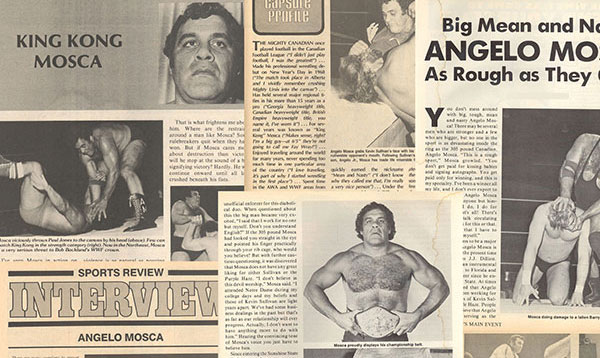
Angelo Mosca was already a well known star by the time he first appeared at Maple Leaf Gardens in 1969. He was in the middle of his second go around with the Hamilton Tiger Cats and near the end of his Hall of Fame career in the Canadian Football League.

He had started wrestling in Ottawa and Montreal in 1960 on a part time basis while earning his reputation as 'Mean and Nasty' on -and off- the football field. He had been in some trouble while at University of Wyoming in 1958. They cancelled his athletic scholarship for 'scholastic deficiency and disciplinary reasons.' He had also been sent away from Notre Dame for similar infractions.

Just around the start of his wrestling career he was in Montreal playing for the Ottawa Shaffers in the Eastern Canada Senior Basketball playoffs (alongside some other CFL'ers earning extra money) when Mosca slugged the referee and was promptly suspended. He had taken a kicking and kneeing penalty earlier in the game and took it out on the ref with a right to the jaw. The coaches hauled Mosca off and convinced the ref not to call the game. Once the ref had visited the dressing room and returned he ordered Mosca to the showers. This time Mosca hit him with a left to the jaw. His own teammates now dragged him to the dressing room and Mosca left the arena while the ref threatened to charge him with assault. That was the end of the playoffs for Mosca who stuck to causing trouble on the field and in the ring.

When he finally made his Toronto wrestling debut years later it was the Sheik era in the city. Mosca got his chance vs Sheik in June 1971, his first main event at the Gardens.

MOSCA GIVES SHEIK TROUBLE
Angelo Mosca, evidently so unnerved at hearing Torontonians actually cheering for him, erred on a flying tackle, wrapped himself around a ring-post and ultimately, lost his wrestling assignment against the Sheik last night. In the autumn, Mosca is a 270 pound lineman with Hamilton Tiger-Cats and seems to rate the most verbal abuse when the Toronto Argonauts are hosting other Canadian Football League teams at CNE Stadium. He forgot however that a Maple Leaf Garden's wrestling crowd would throw roses to Adolph Hitler had he ever faced The Sheik. 
Allan Ryan Globe and Mail June 21 1971

Mosca gave The Sheik trouble but still notched another mark on Sheik's unbeaten streak, then at 49 wins 0 losses and 7 double dq/double countouts. That marked his last appearance at MLG for a time but he remained a regular around Ontario. He spent a few tours with Wildman Dave McKigney, as well as the crossover WWA (Indianapolis/Michigan) cards held around the southwestern portion of the province. He had a tough main event feud with Stomper Archie Gouldie over the Wildman's North American Heavyweight title in summer 1974. At the end of that summer Mosca got into an altercation with a man after leaving a restaurant in downtown Hamilton. The other guy filed charges for assault after he was left with a 'bump on the head and torn clothes after a scuffle' with big Ange. The following year he retired from the field and turned to wrestling full-time.

In late 1975 he returned to MLG, this time as a full out heel playing up his football reputation. In Dec 1976 he faced Andre the Giant in the semi final bout under a rare Sheik title loss (to Thunderbolt Patterson).

BIG ANGE RETURNS
Angelo Mosca weighed 285 pounds when he played defensive tackle for Ottawa and Hamilton. Now, as a pro wrestler, he goes 310. He's on the Boxing Day card at Maple Leaf Gardens Sunday evening up against Andre the Giant. 'I'd done a bit of wrestling when I was playing but I got very serious about it after we won the 1972 Grey Cup in Hamilton, and I retired from football.' says Mosca, who maintains a home in Mississauga, even while travelling all over the continent. 'It's certainly better financially. I'm getting up close to six figures a year.' Naturally Mosca in a villain, as he was in football. 'There's no dough in being a good guy.' he argues.
Jim Proudfoot Toronto Star 24 Dec 1976

When Frank Tunney turned to use the AWA stars in Fall 1977 the stage was set for the now 'King Kong' Mosca to return and this time he stayed. In the AWA he was a heel with the fans chanting 'Ping Pong' in deference to his new nickname. For his first card back Mosca arrived at MLG with AWA champ Nick Bockwinkel and Bobby Heenan and the night was memorable for another reason. There was no ramp. For the first time since 1948 the memorable ramp to the ring was absent. They ran rope where the ramp usually was, with regular steps up to the ring. It was never revealed why the ramp was out but as far as we know it never happened again.

THE MEANEST MAN SAYS HE IS -NOW
Now that he is the heavyweight wrestling champion of Georgia, Angelo would welcome the kind of disaffection which in football, was so completely undeserved. He worked Maple Leaf Gardens , on Frank Tunney's Sunday night show, and he confesses to having developed villainous impulses since he left the refining influences of the Tiger-Cats. 'Even in the Yamaha snowmobile commercials, you get the impression I'm a pretty tough character,' Mosca boasts. 'I am. Well let me tell you I haven't been uunder $65,000 a year since I left football. Best money I ever made in football was $23,000. That was in my last three seasons with the Ti-Cats.' The heavyweight champion is in heavy demand.
Milt Dunnell Toronto Star July 28 1978


He worked his way up the cards facing the top stars of the AWA & WWWF including Chief Peter Maivia and AWA British Empire champion Billy Robinson. For a May 1978 card Mosca was acknowledged as the Empire champ having beat Robinson in an AWA proper bout. That title different from the Empire title Whipper had held here back in the boom days. In July 1978 he made his first appearance as a fan favorite, facing champ Bockwinkel in the co-main alongside a Backlund vs Superstar Graham WWWF Title bout. Almost two months later he got a re-match with Bockwinkel, this time they were the main event over a title bout between Backlund and Gorilla Monsoon.

THE CANADIAN TITLE YEARS

On his next return here the Mid Atlantic era had begun. By early 1980 he was firmly seated to become the main local star on the scene. Previous local stars Dino Bravo and Dewey Robertson, had both finished their main event runs, Bravo had left in 1979 while Dewey was soon to go. With the launch of the new Canadian Heavyweight Title (back in Dec 1978)we had a local title that Mosca went on to hold through 5 reigns.

I'M NOT JUST A PRETTY FACE IN THE CROWD
Angelo Mosca said with mock solemnity at a lunchtime tete-a-tete yesterday. 'When I'm wrestling in the southern states, they bill me as King Kong Mosca. Up here in Canada, the promoters don't bill me as a villain. They are aware of the real me-gruff, rough, but lovable. What does the future hold? If you look after yourself, you can last for a long time in wrestling.' he says. 'But I'd like to become a wrestling promoter somewhere down the line. And I'd like to get back into doing television commercials.' 
Jim Coleman Toronto Sun July 23 1980

Around the time Mosca first won the Canadian title he was also a vicious heel in the WWF, appearing there regularly while holding the strap (he was photographed backstage with the belt but as far as we know never defended the title there). There was no mention of Toronto while on WWF TV, but the magazines ran stories on him where they had observed the personality change depending on the location he wrestled. Mosca replied with, 'I wrestle the same way everywhere. The fans can decide to cheer or boo.' He did and they would. He was back in the WWF gunning for Backlund’s crown and prone to some serious fits of violence. He was managed there by Lou Albano and appeared both on the WWF TV tapings and at the big shows around the Northeast.

This was a bit of a conundrum for the Maple Leaf fans as we got the WWF TV show here at midnight Saturdays on WUTV Buffalo. When he later looked to have killed Pat Patterson with a water pitcher it left many of us scratching our heads.

While Canadian champ, Mosca challenged NWA champ Harley Race. This card was moved to a rare 1:30pm afternoon start as the Maple Leafs were in a playoff series with the New York Islanders (we lost!). Both Mosca and Race were counted out after a tough brawl with very few wrestling holds.

His new-found popularity as the star of Toronto wrestling attracted some mainstream coverage which had been minimal in the recent past. All three Toronto dailies, the Globe, the Star, and the Sun featured full page articles on the wrestling revival, with more coverage than had been seen in many years. Big Ange was the star of several features both in and around Toronto and in other towns on the circuit. On the May 20 1981 episode of the Global Network’s That’s Life, one of the stories was a 'visit with Angelo Mosca.’ On one afternoon in London for a card, he appeared on CFPL radio’s Sports Call and people were calling in for 2 1/2 hours to talk to him. The Toronto Star also ran a full page feature looking at his wrestling and football careers with a photo from a recent MLG bout vs Ivan Koloff.

ANGIE STILL HEARS THE CHEERS
'I built this image,' says Mosca, his face a bloody mask after his bout with arch-rival Ivan Koloff, 'of a guy who loved to be hated and now it's different. All of a sudden, it changes. People Like me, really like me. That's the way it goes in this game. One night you're the good guy, the next you're the villain. It gets confusing. 
Kevin Boland Toronto Star June 18 1981

At the big 50th Anniversary card on Nov 15 Mosca faced Studd in front of 16,000 noisy fans. Our Canadian Title took 3rd semi behind Andre vs Kahn, and the main of Flair vs Race. There was two referees and they brawled their way to the floor where Studd had enough and fled to the dressing room. It left Mosca the winner but not the champ. Mosca eventually regained the title a few months later in a cage bout.


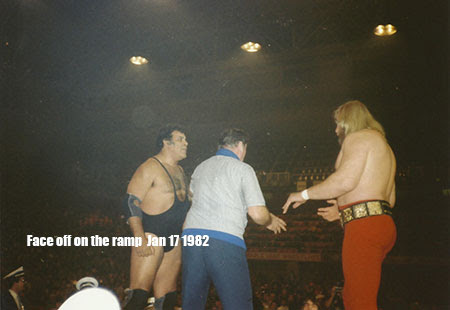
The memorable title win came in Jan 1982. After a bloody Johnny Weaver-Alfred Hayes cage bout they left the cage up for a Canadian Title bout Studd vs Mosca. The two faced down on the ramp as Mosca waited for Studd to climb the stairs. Mosca attacked and the bout was on. It ended with Studd pinning Mosca. It appeared that way anyways. Ref Terry Yorkston, inside the cage as was the case here, gets hit, and in a daze (Yorkston played the semi-buffoon type well) awarded the victory to Mosca. The fans went wild when Mosca grabbed the belt to celebrate but the celebration didn't last long with Studd viciously attacking the new champ. Weaver (bandaged up from his bloody cage bout) along with John Bonello returned to the cage to help Mosca. Both end up taking a beating from Studd before helping Mosca get the upper hand. A bloodied Studd emerged from the cage and took a lot of abuse from the fans on his way down the ramp. Mosca, bloody and beaten emerged from the cage as the new champ to begin his fourth reign with the title. 

In April 1982 the feud between Canadian champ Mosca and Studd continues with Studd announcing he was bringing a mystery opponent to 'permanently maim the champ.' Studd had hyped it for the two weeks previous to the show. Fans were talking and many names were being brought up as to who could be the mystery opponent set to meet Mosca on the Apr 4 1982 card. One of those names was Andre the Giant. Andre was still a few years away from his first heel turn in North America but at the time it seemed like a good idea. When the time came it wasn't such a big name. When Norm Kimber announced Tarzan Tyler, the crowd was disappointed to say the least. Tyler was a ways past his prime by this point and mostly unknown to the younger fans. He had appeared here sporadically from 1964-1978 and was a fine wrestler in his prime but... Special ref Sonny Fargo had been assigned to officiate and the bout was generally a letdown since it had been so highly touted. Mosca didn't have much trouble defending his title.

A big card two weeks later was a double world title night. Flair vs Race and Mosca vs Bockwinkel. The AWA champ was making his first appearance since 1979 and had a tough bout with Mosca. Big Ange battered the champ and looked to be on the verge of winning when John Studd charged the ring and attacked Mosca. He and Bockwinkel laid a beating on Mosca until he was able to fight back and chase them from the ring. Official decision was a dq win for Mosca.

A feud with Gene Kiniski in June 1982 was better than expected. Kiniski, who went way back here (debut 1956) was still as ornery as he was back then. Stomping and snarling, he was a good opponent for Mosca in a short run. Kiniski had held versions of a Canadian title in his career and they played up the mutual football backgrounds and ‘greatest Canadian’ bit.

At the big Night of Champions card in July 1983 Mosca faced One Man Gang in front of anywhere from 16-22,000 fans at the old Exhibition Stadium. At the follow up two weeks later in front of 10-14,000 Mosca lost the title to Sgt. Slaughter.

In early 1984 Mosca beat Sgt. Slaughter to regain the Canadian title and promptly disappeared. He was said to be upset with the low drawing cards in Toronto as the NWA days came to a close. He took the belt and went to Florida for an extended trip often managed by JJ Dillon. As per usual he was a vicious heel -and did defend the title a few times- while the fans up here were left scratching their heads, again.

BLOOD IS THICKER THAN WATER
'We (Sr&Jr) spend 1 1/2 or 2 hours in the gym together working out and in some mat training. Then we drive or fly to the town where we have our matches, then back home to Charlotte. We don't live together. Junior's not married yet, but I have a very understanding wife,' explains Sr. 'The best thing about wrestling is working with this guy right here,' says Junior, thumping his father on his hammy thigh.' 
Alison Gordon Toronto Star May 20 1984

His son Angelo Jr. debuted here in 1984 after Sr. had been stripped of the title for not appearing. 'Injury' was the wrestling reason and they held a tournament for the vacant title with Junior announced as an entrant. Jr. was a good athlete cut from the same cloth as his father. He had attended a Ti-Cat camp for high school players in 1977 (at 17) but in June 1981 he had been cut after trying out as a defensive guard at the BC Lions camp, effectively ending his pro football aspirations. He went on to earn a degree from Concordia University before trying out pro wrestling. After Jack Tunney had switched exclusively to WWF in July 1984 Sr. stayed on for a bit and also announced while Jr. got his brief run with the WWF here. When done, both father and son appeared on the Wildman's Big Bear circuit in and around Toronto.

MOSCA MANIA

By 1985 Sr. was planning to bring the NWA back to Ontario. In Feb 1986 he ran a show at Copps Coliseum in Hamilton. While Hulkamania may had taken over Toronto, there were still a lot of fans from the NWA days. Sr., with a long history in Hamilton, announced the show to be dubbed 'Mosca Mania.' Jr. appeared in an opener. The card did well drawing 12,000 fans with a gate of $140,000 to see a main of NWA champ Ric Flair vs Dusty Rhodes. Mosca Jr. teamed with Vic Rossitani against the Kelly Twins.

At the time Mosca was 50 years old, mostly retired from the ring, and doing TV ads and running several different business ventures around town. A few days after the show in Hamilton he was in Toronto doing a TV commercial for Lite beer and said he made 25k in what was his 14th or 15th commercial since he had done the Schick Razor 'Tell it to my face' campaign some years before.

MEAN ANGELO MOSCA MEANS TO KEEP RAKING IN BIG BUCKS ON TV
It's not only amazing that Angelo Mosca is making a fortune doing TV commercials, but he's making them, period. Don't get me wrong: Mosca's good at them -he has charisma and style- but as the former villainous Mr. Mean of the Hamilton Tiger Cats and, more recently, the villainous King Kong of pro wrestling, Mosca's always held that butts were made for kicking, not kissing.'
Earl McRae Starweek June 15 1985

Angelo Sr. was a guest star on the popular Night Heat TV show, and in June of that year was elected to the CFL Hall Of Fame. In Nov 1986 he was alongside Whipper Watson when Whipper received an award from the Canadian Children's Foundation. Mosca accompanied Whip as he carried a child on his shoulders, as he had done at the many Easter Seals dinners.

Did you know.....The CFL Hall of Fame induction class of 1987 included another wrestler. 
Dick Huffman, a star with the Winnipeg Blue Bombers and the Calgary Stampeders, had wrestled at MLG and around the area in 1956. Maple Leafs - Ti-Cats owner Harold Ballard also in that class.

A month prior to the first Mosca Mania card, he had met with CFL commissioner Doug Mitchell to discuss becoming a goodwill ambassador. The reports later said that the CFL missed the boat by not using him as he was a born promoter and 'mouthpiece.' Sr. teamed with former teammate Len Chandler to promote the show with corporate sponsor Amstel Brewery on Feb 2 1986. It was a huge success with over 12,000 fans and a gate of $140,000. A dollar from each ticket went to the Spinal Cord Society and the fans were treated to a great show.


The main event brought Toronto favorite Ric Flair back for the first time since May 1984 to defend his NWA Title against Dusty Rhodes. At that time Flair was a heel while Rhodes was a fan favorite but the fans didn't want any of it. Flair had long been beloved here and during the Flair-Rhodes bout the fans started cheering Flair. They reversed roles with Rhodes 'second' Baby Doll Roberts interfering. Flair took the win to a huge ovation and the card which also featured the Road Warriors, Jimmy Valiant (always hugely popular here), Abdullah The Butcher, Sgt. Slaughter and a host of local guys was declared a huge success. Longtime MLG ring announcer Norm Kimber, recently let go by the Toronto office, did the introductions for the night.

MOSCA MANIA A HIT
Every now and then the wrestling world has a brainstorm which produces a card that leaves audiences shouting for more. A classic example was yesterday's Mosca Mania, which attracted some 12,000 fans to the Copps Coliseum here. No One left the building disappointed. 
Sam Scrivo Toronto Sun Feb 3 1986

At the time Mosca had declared that he was seeking to become the exclusive promoter at Copps, similar to how the Tunney's had exclusive use of MLG. He also owned the syndicated TV rights for the TV show Pro Wrestling Canada which was produced by the great Milt Avruskin. They showed NWA bouts which were sometimes up to a year old and did voice-overs on the bouts. PWC ran from May 1986 to Oct 1986 on the CTV Kitchener affiliate channel 13 locally but that channel wasn't available to all in the Toronto area.


Mosca later told a reporter that he couldn't get the show on in Toronto and that's what killed it. Doug Bassett, head of the CTV had told him 'it wasn't family oriented television.' At that time they had WWF, International Wrestling from Montreal, and the Maple Leaf WWF shows on TV in Toronto. While the WWF was tame, the International show was a harder style, a throwback to the 70's with bloody bouts and great brawls. If Mosca had been able to last, the Montreal based stars may have appeared here. Bravo, Abdullah, etc. but he would have had to run the Gardens or the EX. MLG was still exclusive so it was limited venues outside of summer months.

EX VILLIAN CHARMS 
'He (Mosca) is president and promoter of Pro Wrestling Canada, with shows on 10 TV stations in the east and two in the west. He stages live shows in Kitchener, Ottawa and Toronto (Varsity Arena), when he is not busy lifting trucks in Chevy commercials.' 
Milt Dunnell Toronto Star Nov 30 1986

He never promoted any shows at Varsity Arena or Ottawa as far as I know. Outside of the Hamilton shows and one in Kitchener the only others of record were a TV Taping, and a card in Peterborough on Feb 17 with Tully Blanchard vs Barry Windham as the main 

The TV show later appeared on TSN as well as CTV and is a good show to seek out. Mosca not the greatest announcer (whole other article) but Avruskin one of the best. Sr. presented another card in Kitchener on Nov 23rd 1986 with a main of Nikita Koloff vs Wahoo McDaniel as Mosca Mania II. This one was a reverse of the first one, several no shows and most of the cast filled out with locals. Only 1.500 showed up, most of whom went to see the Road Warriors. Hawk never showed and was replaced by manager Paul Ellering. Jr. took on Siki and then it was back to the circuit for both Jr. and Siki. Despite the setback it was not to deter Mosca from staging another Hamilton show in Feb 1987.

Unfortunately he ran it on the same night as big WWF show at MLG featuring Roddy Piper vs Adrian Adonis in a 'retirement bout and Savage/Steamboat. Mosca in turn had  Flair vs Nikita Koloff but only drew 3,000 compared to the 17,000 at a packed MLG. On Mosca's show Blanchard battled Rhodes and they reversed roles too with the fans booing Dusty. A fan told me he had 'stickered' the MLG bathrooms prior with notice of the upcoming Hamilton card but it didn't seem to help much. There were rumors of bad payouts on shows (heard years later), and then he sold his interest in it and that was the end of Mosca's promotional tenure.

Both Moscas were featured on the popular CTV show Lifetime which ran the same night as a big WWF show at MLG. Sr. continued to show up in  TV commercials, and various ventures capitalizing on his name. Remember the Peach Pages?; a business directory he started with a partner in 1989. In recent years he had revisited his old Canadian title belt at tribute and fan events in the area, sometimes accompanied by a still fit (and very friendly to the fans) Junior. 

RIP to a true legend of the ring - and the field. 

-AC
From 2005 revised 2021

Photos, nostalgia,  mapleleafwrestling.com collection
Mosca Mania items from Eric Peddle collection
Pics from 1978 out of 'Alias King Kong Mosca' Canadian magazine
The Sheik Streak by Gary Will is at The Sheik's unbeaten streak: 1969-1974: Gary Will's TWH


Wildman, the OAC & Court

Best of mapleleafwrestling.com 2003-2023

Dave vs Sheik in '82

If you are a fan of Ontario wrestling you likely know about Dave McKigney's problems with the Ontario Athletic Commission. In the last years of his promotion he had issues with the Comission over licensing, insurance, using the wrestling bear (also Ontario Humane Society), and other issues. 

The OAC had been an issue for pro wrestling in years past for Frank Tunney and his predecessor Jack Corcoran. Tunney especially though kept the Commission close, and but for a few issues never really had major problems with them. They would impose fines (see Nanjo Singh and Gene Kiniski) and Tunney would iron them out. His esteemed spot within the Toronto and national sports scenes enabled him to work through issues that would later affect McKigney - though Frank did once lose his license to promote at East York Arena for a time -see link at end of article. 

In previous years the Wildman's troupe had toured around Ontario keeping busy through most summers (and some winters) with cards in the smaller towns around the province. He mostly worked on the outskirts of Frank Tunney's promotion and had often used Tunney stars. McKigney had also wrestled at MLG back to the 1950s and had a symbiotic attachment to the big circuit. 

By 1987 that was down to a few spot shows and Jack Tunney who had replaced Uncle Frank in 1983, and once promoted with McKigney, had not been as receptive to the arrangement. 

In that vein, anything from the later era is particularly interesting to come across. This, an OAC report from a card during McKigney's last days in Ontario before going on the fateful tour of the East coast the following year. 


 I asked Toronto wrestler/trainer/promoter and good guy Ron Hutchison if he could add some info re the OAC Report..

'We absolutely had to file these reports with OAC commissioner Ken Hayashi (and before Ken with  Clyde Gray) after the show.  He did expect his 2 per cent tax on the gate, no matter how minuscule that might have been. In addition to the the 2 per cent tax on the gate receipts the shows and the wrestlers working the shows had to be sanctioned by the commission.  

The sanctioning fee for the shows themselves depended on the population of the town you were running in.  If memory serves me correctly any town with a population of over 100,000 people the show cost $300 to be sanctioned and in order for the show to be sanctioned the promoter had to have a $1 million dollar public liability insurance policy as well.

 I remember at one time (when I was working) the licensing fee per wrestler was $5 yearly with the year ending at the end of March.  So, if you licensed yourself on April 1st of one particular year or March 1st of that same year the licensing fee to the commission would still be the same amount. If memory serves me correctly the yearly licensing fee for the boys did go from $5 to, I think $25 and then to $50 per year.'  
-Ron

It's too bad McKigney didn't fill in the payouts. It's not a bad card at 579 paid tickets, though back in the mid/late 1970's they were regularly pulling 1,000-1,500 fans. Tickets at 6-9$ which had steadily gone up since we paid 3-6$ in 1981-82.

The crew listed is mostly the same as the previous year. After Jack Tunney took over for Frank it ended the cross pollination that had occurred in previous years. Chris Colt had been a regular for Big Bear since 1981 while Sweet Daddy Siki, Jet Star, Wolfman Farkus were mainstays in the last years. Mosca Jr. and occasionally Mosca Sr would also join for some shows. As was standard on Wildman cards there was a little bit of everything. A hardcore bout, some ladies (Orser, Rose, Sheena), and the little people.

And what about the other usual presence on Wildman cards? A few years earlier in 1984 Gentle Ben (Dave's latest wrestling bear) had bitten off a piece of the fingers of two young men during an exhibition in PEI. When he returned to Ontario it started a firestorm of problems including Commissioner Clyde Gray banning the bear and making it a condition of the wrestling license.

The incident also brought back the tragic mauling of Dave's girlfriend Lynn Orser by previous bear Smokey at Dave's Aurora home back in the summer of 1978.

The following season (1985) when Gray noticed an ad for Scarboro Arena with the bear listed, he pulled the wrestling licenses putting Dave and the crew on the shelf. McKigney and his lawyer went to the Ontario Supreme Court which reinstated the license but with the same conditions - no bear - until it could make a ruling weeks later. In front of a full house of 1,500 Dave and Ben exchanged a few playful slaps before the cheers turned to boo's as he announced he wasn't allowed to wrestler the bear.

Ultimately the Supreme Court quashed the OAC's cancellation of his licenses. McKigney argued that without the bear he would be unable to attract enough fans to cover the costs of arenas and the 18 wrestlers in the show.

Gray responded that it was not in his jurisdiction to sanction promotions that involve animals and if so 'you might as well throw the athletics out the window,' Dave summed it up by calling Gray arrogant and that 'the Ontario government spends millions of dollars to create employment and I pour money into the economies of all the little towns we go to but they want to close us down.'

It was a small win but the war was soon to be lost. In 1988 due to all of the issues in Ontario Dave took his show back to the East coast - with the bear advertised - but it would be cut short with the tragic accident that killed him, Pat Kelly, and Adrian Adonis.

Mark Greer (l) 1982 and Dave and a wrestler that I can't recall  (r) 1985 with Gentle Ben 


Thanks to Roger Baker
Thanks to Ron Hutchison for his insight- for more on Ron's career get the excellent
Ron Hutchison - Pain Torture Agony - the Book!

-AC

Nostalgia & Photos mapleleafwrestling.com 


Doug Hepburn: Worlds Strongest Man

Best of mapleleafwrestling.com ...

Pro Wrestling has seen it's share of Football players and Strongmen over the years. In Toronto we saw our share of both dating back to the very early days of Pro Wrestling.

With the Red Cross ladies 1955
In the mid 1950's Doug Hepburn turned to the squared circle after taking the country by storm setting Weightlifting records and earning the title of 'World's Strongest Man.' He had won medals, set records in many of the lifts, and won the prestigious Lou Marsh Trophy as Canada's top athlete in 1953. Some ads proclaimed him as 'the strongest man in history.'

He had overcome some serious physical issues to reach those heights and wrestling was to be his next challenge.

A Jim Vipond column in early 1955 claimed that he had signed a 5 year contract with Toronto prommoter Frank Tunney before Christmas and that he was in training under Whipper Watson at the Queensbury Athletic Club basement gymnasium (below Maple Leaf Gardens). He was enduring 3 hour workouts 4 days a week alongside another of Watsons proteges, football player for the Toronto Argo's -Gil Mains. Mains was said to be progressing faster as he had an amateur wrestling background. He debuted at MLG in May 1955.

Teacher Watson spoke highly of his charge saying he thought Hepburn to be 'a much stronger and more agile wrestler than Yukon Eric' and that he may soon pose a threat to all of the strongmen of wrestling. Hepburn weighed in at 295lbs with a 21 inch neck and 57 1/2 inch chest.

Another column spoke of Hepburn attempting to wrestle previously under San Francisco promoter Joe Malcewicz. After enduring endless elbow smashes and other forms of wrestling indoctrination Hepburn had left discouraged. Malcewicz had starred here in the 1930s, the 'Utica Panther,'

Hepburns first appearance in the ring at Maple Leaf Gardens came on Nov 11 1954 when he performed in front of 9,000 fans there to see Watson & Paul Baillargeon tag vs The Great Togo and Tosh Togo. Hepburn did a clean press with 320lbs, benched 450, and then crumpled a can of tomato juice with his bare hands.
With Whipper 1955

After training with Watson he returned on the Mar 10 1955 card to lift a a group of Red Cross ladies sitting on a table. Before the feat he tore a license plate in half and did the same with a pack of cards. He then tore the cards halves into halves again. Then came the big event.

The platform weighed 200 lbs and the girls were said to be 115 each. First they sat 8 girls and Hepburn stood under the beam it was rested on and lifted it off with his back. Then they added 4 more girls and after only getting three corners off was able to lift the whole platform up. He got quite a hand from the crowd and was said to have lifted about 1580lbs total. He had done similar stunts in the past including lifting 6 Vancouver Canuck hockey players the same way

In between he was pictured around town performing other strongman acts including carrying a field gun barrel weighing upwards of 600lbs at HMCS York after nine men had lifted it into the air to shoulder level. He got lots of press posing with local stars and in one photo with former wrestler and 'Big and Tall' founder George Richards, he tests one of Richards mohair jackets by pulling it apart (or failing to).

Photographer and writer Roger Baker observed Hepburn up close one day at the YMHA at Bloor and Spadina.

'I do remember seeing Hepburn wrestle at the Gardens back in the early fifties, also remember the hype that he received leading up to his match with Yukon Eric. One memory of Hepburn stands out in my mind very clearly, it happened in 1955 at The Y.M.H.A. The facility had a room devoted to bodybuilding, as well as weight lifting. There were perhaps twenty five of us young muscle heads who had gathered in the weight room to see the mighty Doug Hepburn honor us with what we hoped would be an exhibition of his incredible feats of strength.

Hepburn did not fail to treat his eager audience to an amazing thirty minutes of his prowess handling of the bar bells, and dumb bells. He had us all gasping as he did the overhead press, the bench press, the dead lift as well as barbell curls. Considering that Hepburn had a clubbed right leg since he was a child, made his exhibition of strength all that more impressive. Hepburn's visit to our weight lifting room at the YMHA. was talked about for months afterwards.' - Roger

His wrestling debut came a week after the Red Cross stunt against Frank Marconi. The bout was quick. 2 minutes and 39 seconds. Marconi was left a 'helpless heap of humanity' after Hepburn snapped a series of holds then grabbed Marconi in a reverse bear hug and 'squished a couple of times' and dropped him to the canvas. Marconi was carried out on a stretcher.

The debut was successful but the next night Hepburn was pulling out from Mutual onto Carlton St in front of a stopped eastbound streetcar and got hit by a westbound one which threw it against the stopped one. Damage to the 2 streetcars was estimated at 45$ while damage to Hepburn's car was about 700$. There was no word of damage to Hepburn.

He continued to appear on the weekly cards making short work of opener types including Mike Paidousis, Alan Garfield, Pete Manganoff, and stalwart Lee Henning.

By May he was moving up and faced Jan Gotch on the undercard of a Whipper-Pat Fraley main. Next up was Pat Flanagan whose haymaker was said to just bounce of Hepburn's midsection.
With Whipper and Miss Toronto 1955
He was the feature of Milt Dunnell's Star column in June and was described as starting to get a cauliflower ear from wrestling. Dunnell claimed Whipper and Tunney had offered to back Hepburn against Russia's 10 leading weightlifters, for each Russian to do his specialty and then Hepburn to do all 10 at the same time. Hepburn claimed his appetite had been exaggerated in the past and Whipper agreed saying he was not eating more at one time than Sky Hi Lee who once ate five steaks and three dozen eggs, and followed it up with a light bulb! Hepburn, Whipper claimed, had not eaten more than one steak and three dozen eggs, and the eggs were scrambled so it was really only a snack.

Another item a short time later had Hepburn issuing the challenge to the Russians. He mentioned that the Canadians should be doing more to help their homegrown athletes. 'Just one Alberta oil well would bring in enough dough to support, train, and feed Canada's top athletes. But do you see governments or associations or anyone in Canada going out of their wat to help our athletes? You sure don't.'

By June he was in the semi main event at MLG vs Karol Kalmikoff. Hepburn had Karol in his reverse upside down bearhug when 'brother' Ivan came out and got his partner disqualified. In the main Whipper faced Ivan and Joe Perlove remarked the next day that one would imagine Whip and Hepburn were likely be teamed the next week vs the brothers as 'yous guys don't know Frank Tunney.'

As predicted Hepburn teamed up with trainer Whipper to face the Kalmikoffs and return over the next few months to work with different partners in mostly tag bouts.

They also team Hepburn up with the high-flying Antonino Rocca for a pair of bouts vs the hated Russian team which resulted in a dq win and then a draw.

Hepburn appeared at the circuit cities as well and kept busy in Niagara Falls, Hamilton, Oshawa, and other towns often working in the main or teaming with Lord Layton, Ilio DiPaulo, and others. An Oshawa bout saw him take on both Kalmikoff's in a handicap bout. He won.

There were later other handicap bouts around the region with Hepburn beating two at a time including an MLG bout where he beat Firpo Zbyszko and Mickey Gold in a bout that 'had the fans in laughter' due to the antics of Zbyszko trying to match strength with Hepburn.

Another handicap bout vs Pat Flanagan and Tommy O'Toole was notable as Flanagan, who started off against Hepburn, got upset with O'Toole for coming in and attacking Hepburn from behind to break the holds. After Flanagan (a fair minded sportsman) told O'Toole three times to mind his own business, he grew disgusted with his partner and tagged him in to face the irate Hepburn. It was all over less than a minute later when Hepburn put his upside down bear hug on and finished it off.

His finisher which had previously been suggested as a 'Vancouver Vise', or a 'Squamish Squeeze' was now referred to a the 'Grizzly Crunch.'

He also sees some action in the West wrestling on some cards in Stu Hart's Stampede area as well as on cards in BC and Winnipeg.

At the October 6 card ring announcer Gerry Hiff read aloud a telegram said to be from Winnipeg where Hepburn was accepting Yukon Eric's challenge to a bout. A previous recap had referred to Hepburn as 'Canada's Yukon Eric' and they had been comparing the two since Hepburn had debuted.

The bout was held on Oct 27 got a lot of press with billing as the biggest attraction in years. They battle it out in front of 10,000 trading strength moves until Hepburn captured Eric in his reverse bearhug. Eric grabbed at the ropes and when ref Bunny Dunlop kicked at Eric's hands the two fell back with Eric on top and Dunlop counted him down. The crowd was said to have been pleased with the bout which saw Hepburn throw a couple of dropkicks and edge the barrel chested Yukon Eric in bodyslams.

He returned to the West for much of late 1955 and early 1956 wrestling regularly in his home area of Vancouver and area.

An item from Vancouver in Jan 1956 proclaimed 'Big Doug Hepburn gives up wrestling.' 'Wrestling is too tough for me' he said in an interview. He said he had made about 25k and netted 15k the first year while Tunney who holds his five year contract said he'd hit 50-60k next year, and 100 k in three years. 'Its a rough business and it's not for me, I just haven't the temperament for it. I've had my nose smashed, my leg hurt, and the boys have been just beginning to turn it on. Right now I'm going to sit tight for a while and maybe get together a touring show troupe featuring a strong man act.'

Frank Tunney responded by saying 'He's a slightly mixed up young man, a bit of a boy who acts first and thinks later.' Tunney says he missed bouts in Vancouver and that he fells he can straighten Hepburn out. Annis Stutjus the former BC Lions coach who had brought Hepburn to training camp for the inaugural season in 1954 remarked 'He came out and then he quit. And you know something? He could have been one of the best. But somebody made a crack to him one day and he never came back.' Tunney added 'Why, he's barely started. He has to build up a following and he's done well for the time he's been at it.'

March 1956 marked Hepburn's last Toronto bout, vs Seelie Samara. He continued to wrestle somewhat regularly in BC up to about 1960

He was said to have had personal troubles in the 1960s but by the end of the decade he had a new venture. An ad in the star in 1969 was looking for distributors for the Doug Hepburn exerciser, 'a portable gymnasium for home or office.'

He was never far from the Sports pages, for each year with the announcement of the Lou Marsh Trophy winner he got some print, and still does to this day.

By the late 1970's he was in the health food business.

As late as 1998 he made the Star in an 'After the Cheering' column. The column kicked off with 'Don't make us laugh, Hulk Hogan. Take a hike, Hercules. The worlds strongest man is a Canadian - and 72 years old.' There is just a bare mention of him having being 'disillusioned by the hokum when he tried professional wrestling.' It goes on to describe him as 225 pounds and having invented a coin operated arm wrestling machine which he hopes to market worldwide.

On Nov 30 2000 he earned a well placed obituary in the Star having passed on at the age of 74. It described him as having tried his hand at a variety of occupations including poet, inventor, dietitian, cabaret singer, and rambling storefront philosopher. There was no mention of his pro wrestling career.

-AC

Big Anthony's & Tony Parisi

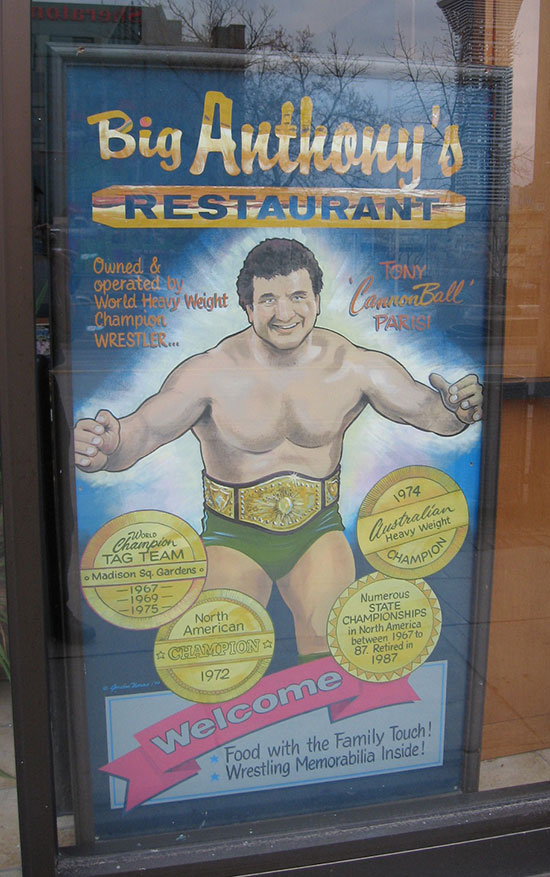
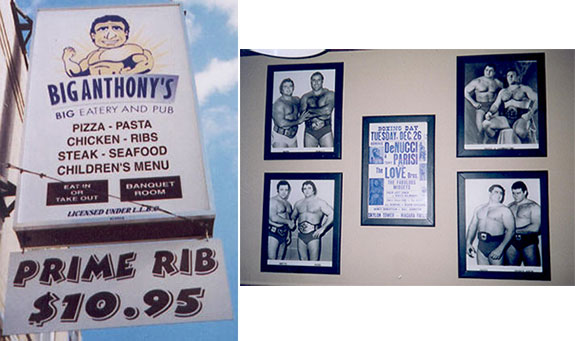
Big Anthony's in Niagara Falls Ontario was a popular spot for many years. Owned by Tony Parisi and family, the restaurant was filled with great photos and nostalgia from Parisi's career, There was even a sitting area roped off like a ring.

I took that in 2006. Quite a poster! 

Parisi had a strong presence in the area since he had moved there in the early 1960s and later opened the Tony Parisi Sports Lounge. He first appeared at Maple Leaf Gardens back in June 1963 and put in a good showing vs Killer Kowalski despite getting the loss. His second bout was against Gene Kiniski before he soon teamed up with Lorenzo Parente in a popular Italian team. Parisi remained a regular on the weekly cards and the busy circuit to 1965, though in other areas he was mostly Antonio Pugliese, Bruno Sammartino's cousin. 

The Italian Connection remained strong as he partnered with Domenic Denucci & Gino Brito in Toronto. When Parisi came back in 1968 teamed with Brito, he was billed as Pugliese (only time as Pugliese here) but didn't stay around long. He was scheduled to be on Dave McKigney's Varsity Arena show in 1971 that went head to head with Tunney but didn't appear. A couple of weeks later he was back in the MLG ring. 

In 1976 he did appear for a rival promotion. George Cannon and his Superstars of wrestling ran at the CNE Coliseum while Tunney moved his 45th Anniversary show up to go head to head. Again no grudges held as Tony was back on the Tunney cards soon thereafter.

Throughout the 1970s Parisi promoted in and around Niagara Falls. Cards at Memorial Arena as well as the Skylon Tower, and at Oakes Park. One card at the Skylon brought in 2,700 fans for a main of Tony vs Waldo Von Erich. Of course in Niagara Tony always won. He also ran the popular wrestling shows at the annual CHIN Picnics in Toronto for many years. 


In late 1977 he took some time off but returned for the exciting Mid Atlantic era. He was still very popular and exciting in the ring. Quick and light on his feet. He would get up on the top rope and lay down like he's sleeping (his opponent was boring him) and other fun stuff. By this time he was mostly in the openers alongside Frankie Laine, The Destroyer (Beyer), Billy Red Lyons, and other skilled veteran types. We were lucky to have some good prelim bouts through this era. He did team with Flair and other stars too, able to keep up with anyone.

With the onset of the M-A affiliation the promotion went back to a circuit, with Parisi handling the Niagara Falls cards. Mostly held on the Monday after the big Sunday MLG card with Flair, Youngblood etc hitting the circuit towns for a couple of dates before heading back south. 
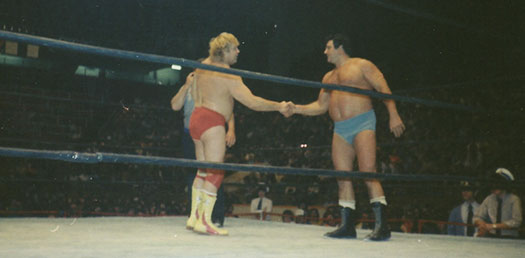
Let the match begin...Apr 1982 MLG -one of my favorite pics

At MLG in April 1982 he took on Ray Stevens, now a good guy after years as 'The Crippler.' They shook hands at the beginning of the bout and had an all scientific type match, one of the best bouts of the era for me. It was a good way to kick off the evening which was also the last time two major titles were defended on the same card. NWA Title (Flair vs Race) and AWA Title (Bockwinkel vs Mosca). 

Parisi passed on in 2000 and the family continued for a time before selling the business. Last time I was by there it was an Indian restaurant. Tony was deservedly inducted into the Niagara Sports Hall of Fame in 2008.

-AC and photos by ...

1980 poster 

Frank Tunney: The Early Days

The Tunney family had originated from Ireland. Frank's great-grandfather Peter Tunney immigrated to Toronto sometime prior to 1849 when he married Bridget Potter in St Pauls Church in Toronto. Peter and Bridget had 7 children. First born Hugh in 1851 married Ellen Quigley in 1873 in Newmarket, ON living life as a farmer before retiring in 1919. Hugh (d. 1931) and Ellen (d. 1933) had 3 boys including first born Thomas Peter in 1875 or 1876 in the township of Whitchurch Stoufville.

Thomas Peter Tunney later settled on a farm in Hagermans Corners near 14th Ave and Kennedy Rd in the town of Markham. Thomas had married Markham born Annie Corcoran (born 1873) in 1901 and they had three children, the youngest of which was Frank.

We can note that Frank's mother Annie bears the same name as the Toronto Boxing and Wrestling promoter Jack (John Jr) Corcoran with whom Frank and brother John began working for in the 1930's. In the marriage announcement of Franks parents on Nov 8 1901 (date of marriage Nov 4) Annie is said to be daughter of one John Corcoran (d.1911).

Was there a family relationship between Frank's mother and his future employer? Corcoran was not an uncommon name but given the fact that Frank went to work for Jack it's quite probable that Frank's mother was related to Jack whose family also had ties to Markham. At least publicly there was no admission of a family connection between the two.

Thomas and Annie Tunney had three boys. First born John in 1907 (d.1940), Thomas Peter Jr. in 1910 (d. 2000), and Francis Martin (Frank) in 1912. It's not clear when Thomas Sr settled on the Markham farm as both John and Thomas were listed as born in Scarborough. The Tunneys first had a farm in the Milliken area (now Agincourt), while Frank is generally listed as being from Markham.

Main pic: Frank & Barry Lloyd Penhale in Tunney's office at MLG 1957

Frank Tunney

Frank, the youngest of the three boys was described as growing up doing the usual farm chores. In 1927 when Frank was just a teen his father passed away at the age of 51. There was to be a considerable amount of tragedy in Frank's family as the years went on.

with French Angel 1942
In a Aurora Ontario newspaper report in August 1933, Frank, described as a former resident, son of Mr & Mrs Thomas Tunney, almost drowned at Harvey's pond north of Unionville. He was swimming with a friend when his friend got cramps. Frank grabbed his friend who was not a good swimmer and almost took him to the bottom of the pond. The friend managed to free himself and called for help. A young man jumped in and saved Frank and a Doctor on scene administered artificial respiration for over an hour, succeeding in resuscitating him. The young man who saved Frank later received a medal for bravery while the others received life saving certificates.

As a high schooler Frank was apparently quite athletic, he competed in football, sprints and high jump at Markham and was said to have won a junior championship. In a 1947 piece (bearing in mind -the usually tongue-in-cheek sports writer) Joe Perlove referred to him as the 'Markham speedball'. 

On Aug 10 1937 Frank married Edna Mary Layola Kirby at St Brigid's Church in Toronto, the best man is older brother Thomas. The couple honeymooned in Muskoka before returning to live in Toronto. They went on to have 4 children including Eddie who worked at the office (accounting side) in the 1970's and later officially as partner with cousin Jack after Frank passed away in 1983. Eddie also had worked for Exhibition Stadium in the 1970's. The Stadium was the scene of several large wrestling cards over the years starting in 1977 and later included the huge Night Of Champions cards in 1983 and the bigger than huge WWF Big Event show in 1986.

A 1944 article from the Stoufville Tribune states that due to physical ailments Frank was unable to join the army but that he was doing his part to ease the monotony of army life by bringing leading wrestlers to the various 'camps' without charge. As far back as 1939 it was noted in the Star that he (and John) were also bringing members of the military to Maple Leaf Gardens to watch Wrestling and Boxing on his dime and was said to have entertained '7 thousand' over the year 1939 alone.

Corcoran and The Tunneys
with Strangler Lewis 1942

In Toronto in the late 1920's the local wrestling scene was growing. Ivan Mickailoff had begun weekly shows in 1929 at Arena Gardens (later Mutual St Arena and then The Terrace, a long time roller rink, a great spot if you grew up in the 1970's) and in 1930 Boxing promoter Jack Corcoran and his Queensbury Athletic Club obtained a wrestling license.

Corcoran, who had been promoting boxing in the city since the 1920s formed the Queensbury Club with Ed Rudd who ran the Rudd Athletic Club. Jack grew into the leading wrestling promoter in the city, arranging to be the matchmaker for shows at the newly opened Maple Leaf Gardens in 1931. Corcoran was said to have partners in Paul Bowser and Toots Mondt. His first card at MLG on Nov 19 1931 fell a week after Frank's 19th birthday.

Frank is placed in the office circa 1931 or sometimes 1932. He was initially described as a 'secretary' while brother John was later to be the 'matchmaker'. There is nary a public mention of brother John until March 1939 when he is described as taking over matchmaking duties for an ailing Corcoran for the March 23 card. Frank merits public mention earlier as both 'boxing promoter' and secretary in 1938.

When John passed away suddenly soon after his 32nd birthday in January 1940, it noted he had been handling duties for Corcoran for 6 years placing him in the office about 1934. Corcoran was still listed (publicly anyways) as 'Matchmaker' into 1939.

In a 1986 story on John's son Jack (who took over after uncle Frank passed away in 1983) it notes that 'Jack has been promoting since 1956', Frank and John 'since the Gardens opened in 1931'. By that time it was a long way removed from the 1930's. In various obits it put nephew Jack in the office as early as 1952. Other stories on Frank or MLG later in the 1970's and 1980's generally refer to Frank having 'promoted since 1931.’ While he may have been in the office at that time he didn't promote officially until 1939-40

In a 1948 article on Frank, it mentions he came to Toronto to take a 20$ a week job. A later article put it at 15 a week. An item in the Liberal (Richmond Hill) Social page has him attending business college in Toronto as of Feb 1930. In an obituary in 1983 it placed Frank in the office around 1931 straight out of business college. In another article from 1980 with Frank's comments it says he hopped the local (bus) with his diploma from Markham Collegiate and took his first -and only -job at the Queensbury Club. He (Frank) mentions that he 'wasn't all that interested in the fight game, bit I liked the place'. He goes on to say 'I liked Jack (Corcoran), a very fine man, like a father.'

with Red Shadow and Manager 1943
In June 1951 Frank's 3 week old son died after being found in his crib with breathing difficulties. Another son Frank Jr. later passed away after a battle with cancer in 1978 at the age of 38. Both Eddie and Frank Jr. had made the Star paper in a 1948 photo of them play wrestling at the Tunney home with the visiting 'Wild' Bill Longson.

On Apr 16 1938 at the age of 65, Frank's mother Annie passes away at her home at 102 Oak Park Ave, Toronto. Services are held at St Brigids.

In 1939, Jack Corcoran took ill and Toots Mondt came up to run a show while he was away from the office. There was a front page story not long after about an incident on Lake Simcoe where Corcoran and others almost drowned after his boat capsized on a day out on the water.

John & Frank Step Up 

Around that time John and Frank buy the now on-the-downside promotion from Corcoran. Other investors are said to include Paul Bowser, Jack Ganson, and Jerry Monahan while the boxing matchmaker is 'Deacon' Allen. Perlove states in a March 1947 bit that John and Frank had lost $2700 in the first 3 shows they put on after taking over. Perlove called John the 'hustler and scuffler of the outfit'. Corcoran was also promoting Ottawa at the time and John became matchmaker for those shows. Monahan, a former wrestler, was described as as Frank's right hand also promoted in Buffalo & Pittsburgh, PA. He was close with Frank but passed on after an illness in 1947. 

Jack Corcoran somewhat retires from the promotion soon after passing the reins to John & Frank. He does stay on in a limited capacity, mostly helping with the boxing side, and from all accounts was very well respected in the city. He sets the tone that Frank continues for many years. That of the unassuming anti-promoter type, not very common in the Wrestling or Boxing world of the day- and close with the media of the day.

While later articles refer to the Tunneys taking over for an 'ailing Corcoran' (in addition to the boat accident he also had a nasty bout with the flu early in 1939), Jack appears to have wanted to retire at that time to pursue other interests. He retired at the relatively young age of 47 and went go on to spend another 25 years in the city. The near death experiences on the lake and with the flu may have expedited his decision.

A 1941 story quoted Montreal Promoter Eddie Quinn as saying that Corcoran was still receiving 5% of the gate from Tunney's shows while he is referred to in the late '1940's as 'retired from everything' and 'keeping a low profile.' When noted athlete Lionel Conacher died in 1954 Corcoran was one of the guards of honor at the funeral, alongside Primo Carnera (Boxing champ, also wrestled), Red Dutton (NHL Exec.), and others. He was active in real estate in Toronto since the 1920's owning several buildings including the Queensbury Hotel on Scarlett Rd as well as Nealon House on King. He also owned racing thoroughbred horses from the 1930's up. He passed away in 1965 at the age of 73.

A June 1939 bit in the Ottawa paper mentions a 'New Deal campaign to bring fans back by eliminating the so-called champions, masked wrestlers, kicking, eye-gouging, hair-pulling, fights outside the ring and mauling of refs. Real old-fashioned wrestling with real holds is to be the vogue.' Said to include Promoters Paul Bowser of Boston, Tom Packs of St Louis, Jack Ganson of Montreal, John Tunney of Toronto, Jules Bauman of Rochester, and Hans Furst of Syracuse. A.E. Long, the Eastern Rep for the Ontario Athletic Commission gave his approval.
with Fred Atkins 1949

On June 5 1939 in Toronto under the byline 'King Kong Cox refuses to accept 'New Deal' bout, John Tunney announced the cancellation of the June 8 card with Dan O'Mahoney. Under contract he offered the bout to King Kong Cox on the condition he obey his edict and cut out the rough stuff. Apparently Cox refused to change his style and Tunney announced the bout was off and Cox would not be allowed to return until he was ready to wrestle instead of 'act like an enraged animal'. Seems quite comical now but the Athletic commission in those days was frequently involved, giving fines and such. They even reprised the idea on the smaller circuits later as 'real wrestling.' Suffice to say nothing much changed in the ways of the ring.

Though he had apparently already passed the reins to John and Frank by this point, in a Sept 4 1939 bit by Fred Jackson Sports Editor at the Star he reports 'business back as usual at the Queensbury Club. Corcoran back from his prolonged vacation and near fatal trip on Lake Simcoe, Deacon Allen back from California with Jimmy Webster, (and at the office) Frank and John and Phil Lisner.'

After a summer break the Oct 19 1939 show promoted as the first show of the season, Corcoran is still named. As of Nov 1 1939 he is listed as chair of Sports Service Leagues wrestling and boxing committee. At the end of the year on Dec 26th he is still named as boxing head at the office.

In Jan 1940 just a few days after his 32nd birthday John Tunney passed away suddenly. He left behind wife Fidelis Merrick (d.1969) and 4 children (one a newborn) including John Jr. aka Jack who later joins his uncle Frank in the office.

We will note that when Fidelis passed away in 1969 she was listed as Thomas Tunney's wife. When Thomas died in 2000 it listed his first wife as Fidelis Merrick. We could assume if that is correct, that Thomas stepped in to help John's young family as was not uncommon in those days. Later family notices seem to confirm this.

In John's obit it mentions his father Thomas was second cousin to Gene Tunney boxer. There is nothing definitive to indicate that is true. Though it is possible, both families following a similar path from Ireland. Some of the Tunney's did bear somewhat of a resemblance to the champ at different times in their lives. Boxer Gene also had a famous son John - a long time U.S. Senator.

Frank Takes Over

The card scheduled for Jan 19 was postponed and on the 20th Frank was said to have 'assumed matchmaking duties for the Queensbury Athletic Club' and was said to be 'brother and partner' of John. The obituary in the Ottawa paper described John as 'First Lieutenant' for Jack Corcoran, a 'genial soft spoken man, reputation for being sincere, a capable executive, a gentleman, and a good sportsman.'

In the 1940's in addition to Toronto, Frank was promoting Ottawa as well as shows throughout Ontario. Whipper especially was in high demand after beating Bill Longson for the NWA (National Wrestling Association) Title in 1947. He appears on shows across the province from Ottawa to Windsor where Bill Thornton was the promoter with Frank getting co-promoter billing on those shows. Whipper continued to have working ties to the office through to the early 1970's and branched out to promoting smaller shows (in alliance with Frank) in and around Toronto in the 1950’s and 1960's.

Star of the 1940's Pat Flanagan also became a big part of the promotion on the inside. In addition to being one of the more prolific wrestlers (and referee) in Ontario from the 1940's to the late 60's, Flanagan worked as a type of booker for Tunney. Barry Penhale told me that Flanagan was the person who set up the outside towns as far as supplying the wrestlers to the local promoters. He formed close bonds with the area promoters such as in Oshawa with young promoter Pat Milosh.

In Oshawa at least, it ran with Milosh booking the arenas, doing the advertising, and running the shows. Part of the net proceeds go back to the office in Toronto. Frank frequently had Pat as a guest at MLG for parties and such. He appears to have maintained a close and very amicable relationship with most everyone he dealt with.

Along with Whipper and Flanagan, other former wrestlers formed the core of the office both during their wrestling days as well as after, some in non-official roles. Earlier stars including Al 'Bunny' Dunlop and Kenneth 'Tiger' Tasker stayed on for years as referees as did Bowmanville star Billy Stack. Fred Atkins, after a lengthy career later became a trainer and manager (said to have trained Dick Hutton prior to his NWA reign and also notably Tiger Jeet Singh and Giant Baba) and refereed right up into the 1980's. Athol Layton remained close to Frank while another former star Billy 'Red' Lyons became a TV commentator as his career finished.

With many of the other towns it was set up similarly where each town or area had a promoter who took care of the shows while working in tandem with the Toronto office. Along with Milosh, there was Joe Maich for Brantford and area, Sammy Sobol in the Niagara region, even the Northland group run by Larry Kasaboski often featured talent sent up by Tunney 'direct from Maple Leaf Gardens'.

It should be noted that at the 1954 NWA convention Tunney who had been elected as vice-president complained about Kasaboski going into his towns and under-bidding him to promoters. Kasaboski did try to make some inroads in the outside towns (Barrie, Peterborough etc) but never got close to Toronto. As with Tunney's on and off again relationship with Dave McKigney later the feuds appear to be few and far between. Whipper too promoted shows in alliance with Tunney in and around Toronto in the 1950's and also join Frank at the NWA conventions starting in 1954. Whipper himself  became a member a year later when he bought into the Seattle territory staying until 1956.

John Katan who had been a big star in the 1930's and '40's also played a big part in the Toronto history in those early days - in the Hamilton area. Katan became the promoter of the town and running it with Frank's help and wrestlers it became a major stop on the Canadian circuit. Hamilton was also the site for Tunney's TV for many years.

Although Frank wasn't one to get too involved on the wrestling side as far as angles with the wrestlers, in 1941 there was an alleged lawsuit by Whipper against Tunney in regards to a breach of contract. Whipper claimed he had been signed to wrestle in the main event against Masked Wolf. When Tunney held an open tournament to determine the number one contender for the world title on May 1, 1941, Watson submitted a copy of his entry form to the Ontario Athletics Commission so that Tunney couldn't claim he didn't enter. He then won four matches in one night to win the tournament. That was the beginning of the 30 year run with Whipper on top.

To Frank's credit, especially as a young promoter in the position he was thrust into, in a 1947 story it was said that Bowser, Gannon, and Monahan had all been against the big push for Whipper. As the 'Pride Of East York' Watson became the home town favorite earning both the NWA (Association) title in 1947 and then the NWA (Alliance) title in 1956. The once national British Empire Title became Whipper's hometown title which was defended around the country again when Tunney had national TV in the 1950's. It proved to be the decision that saved Toronto wrestling.

In 1945 Frank makes what may have been his only appearance as a referee. He officiates a bout between Whipper Watson and Whitey Hewitt at the Coliseum on a mixed Boxing-Wrestling card for the Armed Forces.

An item in the Social section in Nov 1948 shows Frank & Mrs Tunney hosted a party at their home after the Loretto dance. Guests included Mr & Mrs Winnett Watson (Pat Flanagan), Joe Perlove, Frank's brother Thomas, and a William Tunney and their wives. Also notable is a Miss Lorraine Henning who became Frank's second wife after Edna passed away on the last day of December 1969.

A 1948 article offers a peek inside the office. It reports 'he (Frank) and staff use 4 rooms and a basement in the NE corner of MLG. His private quarters are well secreted you peer through a little wicket at Frank Ayerst who does a Houdini under his deck. there is a click and presto, you are past the outer guardian or tiler and into a cubicle where nine times out of ten, Phil Lisner confronts you and shakes hands. No doubt Frank has to screen himself from tumultuous wrestlers who, like grizzlies, are playful.' It goes on to describe that office as 'overstuffed, its walls reeking with pictures of assorted fighters, wrestlers, and friends, which Jack Corcoran occasionally uses. The back office where Tunney resides behind a desk 'that wouldn't shame the untidiest editor in the business for the infinite variety of its charming disorder.'

The office once occupied part of the space that became the Hot Stove Lounge, site of many Tunney press conferences and parties. A large portrait of Frank hung on the wall there for many years (alongside one of Whipper) and when Frank passed on his friends and peers gathered there after his funeral.

Tunney also had points in the St Louis office starting in the 1940's. He had formed a relationship with then St Louis promoter Tom Packs and when Packs retired in June 1948 he (Packs) sold his interests in the World Title and offices to Thesz, Bill Longson, Tunney, and Quinn. A year later, Muchnick and the Thesz outfit formed a partnership and Frank followed. At the 2nd annual NWA convention in November 1949 Tunney was present representing Toronto. A later correspondence states that Tunney, along with Bill Longson, Bobby Manganoff, and Whipper Watson held about 34% share in the St Louis Office.

When Frank passed away in 1983 Sam Muchnick commented "I first met Frank 46 years ago, we were kids, working for big promoters, and we were witnesses at an anti-trust trial (to do with wrestling) in Columbus, Ohio. It was declared a mistrial -as good as a win- and even better, I acquired a friend for life."

Muchnick chuckled at the memory of Tunney's casual approach to business matters. "Frank had a piece of the action when I was running shows in St. Louis," he said. "I'd mail him a cheque every so often but lost of times years would go by before he'd cash one. The bank would call up to see if they were still any good. They'd have been buried in a pile of stuff on top of his desk. "One time he asked me to pull something out of the heap. It was a hydro bill from a year before. 'Guess that's why they shut off my power,' he said. I pulled again. It was an envelope with several $100 bills in it. He had no idea where that came from."

Boxing

In the early to mid 1940's there were several boxing promoters in the city alongside Tunney and Deacon Allen. Playfair Brown was the most active. Sam 'The Furniture Man' Keller was another promoting shows at the CNE Coliseum and at least one card at MLG back in 1937.

Lil' Arthur King a Toronto native and regular at the Massey Hall amateur boxing cards made his debut at MLG for Tunney in 1946. In the midst of a successful career King switched managers from Dave Yack to notorious Philadelphia mobster Blinky Palmero in 1948 and see his career suffer as a result. In 1956 Tunney helped arrange a buyback to bring King back to Toronto and King was forever thankful for it.

In 1956 Toronto native George Chuvalo turned pro and beat 4 opponents to win the 4th annual Heavyweight Novice Tournament run by Tunney and Deacon Allen in co-sponsorship with Jack Dempsey. Chuvalo went on to have many bouts at MLG under Tunney including a 1966 title bout vs Ali where he lost by decision. Afterwards Ali called Chuvalo 'the toughest guy I ever fought'. Chuvalo was managed by Deacon Allen up to 1964 when Chuvalo moved to Irv Ungerman

Frank with Chuvalo and Deacon Allen 1959
While the boxing side brought some success, there were many problems from the start. Illnesses and problems with the commission and other promoters took its toll.

Tunney worked with - and against - his counterpart in Montreal, Eddie Quinn. Quinn also promoted both wrestling and boxing. In 1945 the two combined to contribute to an Ottawa area boxing & wrestling (mit-mat) card with proceeds to Armed Forces. In 1958 Quinn offered Tunney 10% of the receipts to move an Archie Moore - Yvon Durelle bout from Montreal to Toronto to escape Montreal's Athletic Commission tax of 5% and the taxing of American Television coverage of the bout. Toronto's was only 2%. The bout and a subsequent one ended up being fought in Montreal.

Another dealing with Quinn in 1962 saw Tunney getting an injunction to stop a fight in Montreal between Archie Moore and Robert Cleroux after Cleroux had failed to abide by a contract to face Chuvalo in Toronto and had been barred. The fight was called off with Tunney commenting that Quinn had saved him further legal expenses in the matter. Quinn sees his boxing license suspended for his actions surrounding the booking and promotion of the bout and never promote boxing again, but still promotes a wrestling card at the Forum 2 days later. He subsequently loses the wrestling license too but regain it continuing to promote until he retired in 1963. Quinn dies soon after in 1964

Quinn also promoted wrestling in Ottawa (with Tunney moving out) starting in 1946. There was said to be tension between the two as Whipper Watson was being promoted by Tunney as a Canadian Champion while in Quinn's realm of Montreal-Quebec-Ottawa his star Yvon Robert was regarded as Canada's best. Robert also worked for Tunney both in Ottawa and Toronto as a Canadian and World champ. After Quinn moved in to Ottawa, Tunney didn't return to the nations capital for another 35 years, running shows in 1982.

Tunney also had issues with promoter Howard Darwin in Ottawa -and also involving fighter Robert Cleroux. Darwin who was promoting boxing and wrestling in Ottawa in the early 1960's was forced to cancel a proposed bout between Cleroux and Cecil Gray again because of the suspensions over the previous Chuvalo-Cleroux problems. Tunney threatened to take out an injunction to stop the fight while the OAC threated to pull both Darwins boxing and wrestling licenses. The bout eventually went ahead with Ottawa area alderman Robert Guertin stepping in as promoter.

In 1966 Tunney again got the better of Darwin when he was said to secure the Cassius Clay- Ernie Terrell bout at MLG ahead of second choice Hull (Hull is directly across the river from Ottawa). The bout was originally scheduled to take place in Chicago but was canceled after Clay made anti-war statements in the media. Other cities refused to host it and when it was sanctioned in Toronto, Conn Smythe the builder of MLG and a veteran himself resigned as Director of MLG and sold all his shares in protest.

Harold Ballard, then Executive VP of the Gardens announced how the gate was going to be split up, a look inside the boxing side at the time. Clay receive 50% of the gate, Terrell 20% with the Gardens taking the remaining 30%. Tunney put a guarantee in excess of 96k while a full house of 17,500 paying from 10-100$ would net approx. 195-225k. The fight did go ahead on March 29th but Clay's opponent due to Terrell backing out amid a contract renegotiation - was George Chuvalo. Tunney notably shows up at the glove ceremony with the wrong size gloves.

For Tunney, the wrestling side proves to be far more profitable and easy to manage compared to the boxing side. In 1969 on the occasion of his 30 years as Wrestling promoter Frank reflected on his time in boxing in a Jim Proudfoot article and summed it up as 'It got to be a joke after a while'.

In contrast to his often problematic dealings with others in the boxing game, Tunney had much more success on the wrestling side. Wrestlers and promoters alike had only good to say about the genial promoter. Along with St Louis head Muchnick, Frank was close with Vince McMahon Sr in New York and was well liked and respected by the others in the NWA membership. Many wrestlers over the years including Lou Thesz, Bruno Sammartino, and Gene Kiniski had nothing but praise for Tunney, both about his honesty in payoffs and his easygoing demeanor.

Frank with Whipper 1950
He was however not above a good rib, as was just part of being a wrestler in those days. He had a 'electric chair' in his office for many years that was hooked up to an electrical charge and once inviting the unsuspecting mark into the chair he set off an electric shock. No-one was spared even Thesz who was said to have jumped the highest. One writer was remembered as having on long underwear under his suit and sitting through the whole shock with nary a response.

In the early days it was evident that the sportswriters in the city were in a quasi-working type relationship with the office. Joe Perlove in particular was almost an extension of the office and was close to Frank for many years. His creative and often humorous recaps of the bouts in the Star come off not dissimilar to what a good publicity director would put out. Frank was an astute promoter, he definitely knew the advantage of having the writers close to the office, both with Perlove and with Ayrest. Perlove also covered horse racing and was present at many of the 'clambakes' at the King Edward Hotel where much of the boxing and wrestling business went on in the old days, He passed on in 1966. Star sports editors Milt Dunnell and later Jim Proudfoot both had sidebar columns frequently covering wrestling with features and tidbits from behind the scenes.

In an interview in 1980 Frank had this to say about the scribes. 'That old Queensbury was a nuthouse and I loved it! And you know who the biggest crazies were? The Newspaper types...I don't know how they got away with it, hanging around all the time. And then there were the guys who had nothing to do but sit around reading the Racing News all day. They didn't even watch the workouts.' That Racing news comment refers to Joe Perlove, Deacon Allen, Corcoran, and others that were involved with Horse Racing in some respect, either writing about, betting on, owning them, or all three!

A notice in the social section in Sept 1954 listed the marriage of Teresa Tunney, daughter of Mr. and Mrs. Thomas Tunney with the reception held at the home of Frank Tunney. Jack Tunney, brother of the bride was an usher. 

By this time Toronto had become one of the major centers in the wrestling world while Frank was recognized as one of the top promoters in the business. We will look at the rest of the 1950s through the M-A era in a future piece.


-AC

Info from the Toronto papers, Ontario archives, Oshawa library microfilm, genealogy sites
Barry Lloyd Penhale, Gary Will, Roger Baker, and conversations with others over the years
Photos & Nostalgia mapleleafwrestling.com collection
Originally posted 2015 Info is as presented. With respect……